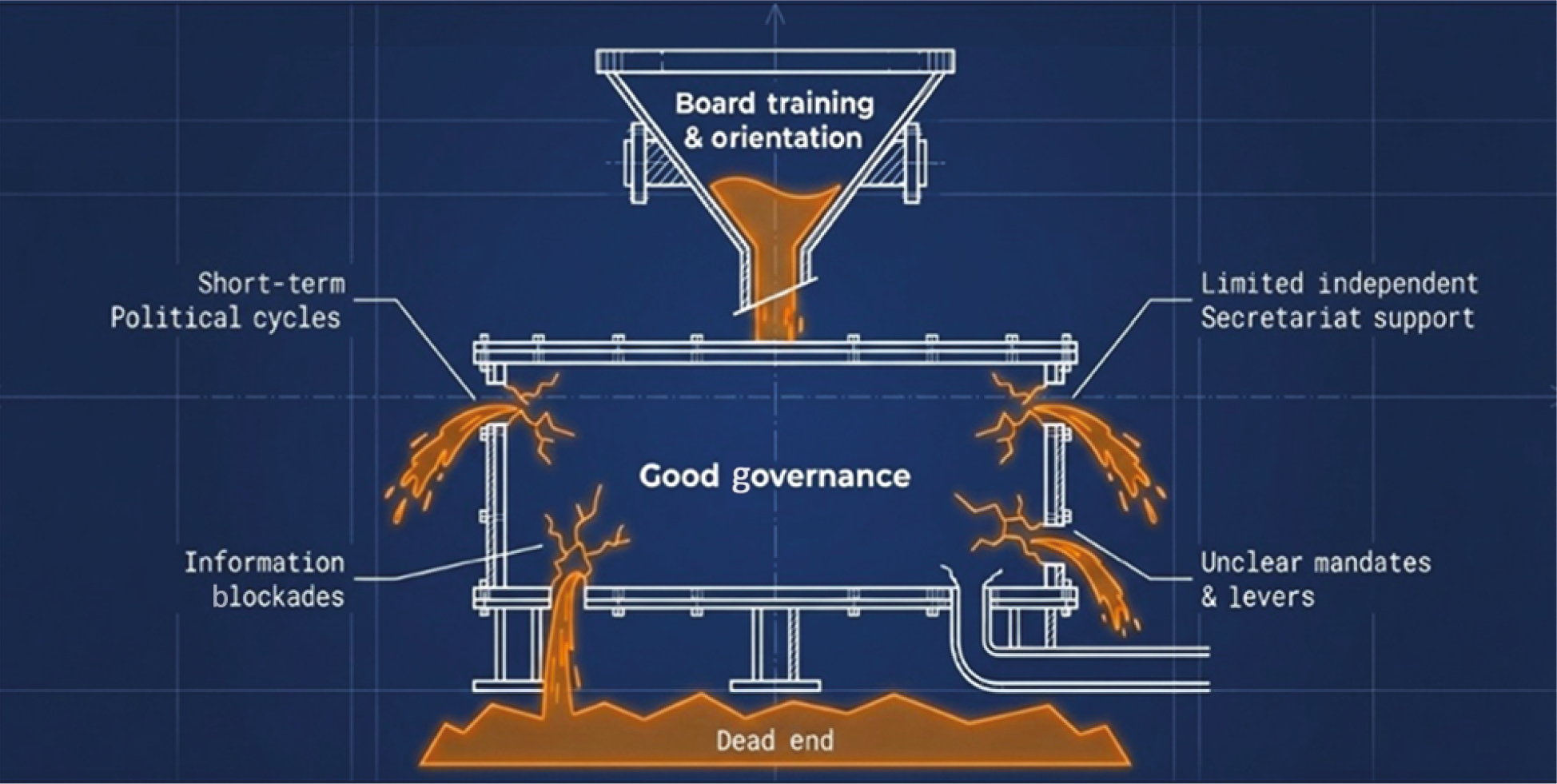
FIGURE 1 The illusion of the highly functional board.
| Journal of Community Safety and Well-Being (2026) 11(3), 153–160. | https://doi.org/10.35502/jcswb.580 |
Cal Corley∗
ABSTRACT
Police boards across Canada bear full public accountability for local policing yet are structurally ill-equipped to govern effectively. Drawing on a succession of major public inquiries – including the Morden Report (2012), the Sinclair investigation of the Thunder Bay Police Services Board (2018), the Rouleau Commission (2023), and the Nova Scotia Mass Casualty Commission (2023) – this article diagnoses three deep structural deficits that have reduced civilian police governance in many jurisdictions to little more than a facade. First, the quasi-constitutional doctrine of police operational independence, while essential to democracy, has been routinely misapplied by police executives to deflect legitimate board oversight. Second, boards overseeing multi-million-dollar police budgets are themselves funded at levels that preclude independent legal counsel, dedicated secretariat support, or research capacity. Third, flawed board composition and short, politically tied appointment terms systematically impede the accumulation of institutional knowledge and expertise that effective oversight demands. Together, these deficits create a structural power imbalance that consistently favours the governed over the governing – an inversion that undermines the legitimacy of civilian oversight. The article proposes the concept of “operational responsibility” that reframes the board–police relationship and offers a practical path forward for governance reform, including skills-based appointment processes, statutory minimum funding standards, staggered board tenure, and codified data rights. As Canadian policing becomes increasingly complex and moves toward a broader community safety and well-being model, strengthening the structural foundations of police governance is not optional – it is a democratic and public safety imperative.
Key Words Police boards, police service boards, police commissions, police governance, civilian oversight, operational independence, board composition and tenure.
Police boards across Canada face a deepening crisis. They bear full public accountability for the adequacy and effectiveness of local policing, yet structurally lack the levers, authority, and resources needed to govern effectively. Over the past 15 years or so, the default response has been to call for more board training – valuable, but not sufficient on its own to fix a broken governance model. With the growing complexity of policing and community safety, it is time for an honest look at the three deep structural issues that have rendered police governance in many jurisdictions go little more than a facade.
The evidence is overwhelming. Over the past decade, a succession of major public inquiries – the Morden Report on the G20 Summit (2012), Senator Sinclair’s investigation of the Thunder Bay Police Services Board (2018), the Rouleau Commission report on the 2022 Ottawa convoy crisis (2023), and the Nova Scotia Mass Casualty Commission (2023) – has each reached similar conclusions about systemic failures in police governance. These are not isolated incidents. They are symptoms of a governance model out of sync with the complexities of modern policing.
Three deep structural deficits lie at the heart of this dysfunction:
These are not problems of individual or group competence. Rather, they are predictable consequences of a governance framework that has remained largely unchanged even as demands on it have grown dramatically. Addressing them requires more than incremental adjustment: a fundamental rethinking of the structures, resources, and relationships that define civilian police governance in Canada.
This article offers a clear diagnosis and a practical pathway for reform. It examines the governance landscape and cultural dynamics that shape it and then turns to three structural issues that undermine board effectiveness: misapplied operational independence, chronic under-resourcing, and flawed board composition and tenure. It concludes with a proposed framework for durable, evidence-informed reform.
The landscape police boards are asked to govern is shifting rapidly. Organized crime, cybercrime, human trafficking, and the proliferation of artificial intelligence are outpacing the capabilities of many police agencies. Complex social issues (e.g., addictions, mental health, housing instability, anti-social behaviours) require multi-disciplinary responses well beyond the police mandate alone (CMNCP, 2020). Together, these trends place new expectations on police – and, by extension, their boards – within the broader community safety and well-being (CSWB) ecosystem.
As far back as 2014, the Council of Canadian Academies (CCA) recognized that policing was transitioning into a multi-actor “safety and security web” – what is now often called the CSWB ecosystem. Anticipating that as the police increasingly partner with public health, social, and community services, the remit of police boards would need to correspondingly expand into broader “public security boards” overseeing multiple public and private providers (CCA, 2014, pp. 83–84). More than a decade later, the foundational architecture of most boards remains narrowly constrained.
As a result, boards are facing demands unlike any before: understanding emerging technologies, overseeing in-service training, grappling with recruitment and retention crises, managing rising costs, and selecting the right chief to drive reform – all central to the effectiveness of police agencies and, ultimately, community safety.
Compounding these challenges is a deeply rooted power imbalance between boards and the executives they oversee. Police chiefs and their leadership teams hold an inherent informational advantage: they know the profession intimately, control operational data and institutional knowledge, and are immersed in service delivery. Board members, by contrast, are typically part-time appointees or elected officials who depend on that same executive for the information needed to make informed decisions – often leaving boards reactive, responding to what the chief presents rather than proactively setting direction (Graham, 2018, p. 11; Laming & Valentine, 2022).
This dynamic is reinforced by police culture itself. Canadian policing is grounded in paramilitary command-and-control systems, policies, and practices. Officers are trained to take charge, and that expectation usually carries upward through the ranks to the executive level (Murphy & McKenna, 2007). Chiefs, shaped by decades within this culture, can (often unconsciously) carry that orientation into the boardroom – acting less as employees accountable to the board and more as independent leaders who set the agenda and pace of change. When boards lack the confidence, expertise, or system supports to assert their authority, the relationship can invert, with the executive leading the board rather than the reverse (Graham, 2018; Stenning, 2021).
And yet, the foundation on which boards are expected to perform these functions continues to deteriorate. These are not individual failures or failures of will, but the product of structural deficiencies and deeply embedded cultural dynamics that, left unaddressed, will continue to undermine effective governance.
“Police board members who try to [set policy and ask tough questions] are quickly trampled by city lawyers, police commanders, or provincial governments for fear of violating the gospel of ‘no operational direction.’” (Kelcey, 2022)
Against the backdrop of longstanding ineffective police governance (Corley et al., 2025; Roach, 2022, pp. 86–90; Sears, 2022), the reflex response has generally been to prescribe more training and better orientation. Hodgkinson et al. (2023) found that over 71% of board members across Canada received less than 10 h of training, and that its content was often underdeveloped. The 2023 final report of the Independent Expert Panel to the Thunder Bay Police Services Board found that even after the board received expert governance training following Senator Sinclair’s 2018 review, meaningful gaps in effectiveness remained. As the Panel observed, board training is important, but it “is not the panacea for enhancing board competence and effectiveness” (p. 35).
The instinct to prescribe more and better training is understandable, but training alone cannot carry the full weight of reform. Pouring more training into the top of the funnel (see Figure 1) does little good if the system beneath it is riddled with structural leaks that good governance can never fill.
|
|
||
|
FIGURE 1 The illusion of the highly functional board. | ||
Those leaks are well documented: short-term political cycles that corrode institutional memory; information barriers erected by police; the near-total absence of independent secretariat support; and mandates so unclear that boards cannot confidently act on them (Corley et al., 2025; Hodgkinson et al., 2023; Roach, 2022, pp. 86–90). Training alone cannot compensate for such a fundamentally flawed framework.
Training alone cannot compensate for a framework that is itself structurally unsound. Three deep fractures run through the Canadian civilian police governance model – each serious and, together, a cause for real concern.
“I have seen police operational independence weaponized, and it’s basically the same ‘back off’ even on strategy… ‘No, that’s operations you can’t put a strategy in place. Because your strategy is going to impact how I operate.’ Well yeah, but that’s the way it’s designed.” (Former Deputy Chief of a major Canadian police service – Interviewed, 2022)
Police operational independence is a quasi-constitutional principle established through several superior court decisions, most notably the Supreme Court of Canada’s decision in R. v. Campbell (1999). While governments – generally through police boards – decide policy issues about policing, they must refrain from directing matters such as whether and whom to investigate, prosecute, or arrest; in our liberal democracy, such operational decisions rest solely with the police (Corley et al., 2025; R. v. Campbell, 1999; Roach, 2023).
But this quasi-constitutional principle designed to protect democracy has, in practice, been mutated into an escape hatch. Police operational independence is not well understood and has been frequently invoked by police executives to block legitimate oversight of non-operational issues of finance and strategy. For example, a board requests data to fulfill its governance mandate; the executive labels the request “operational” and refuses; the board, fearful of violating the law, retreats (Corley et al., 2025; Kelcey, 2022; Roach, 2023; Rouleau, 2023: Vol. 3, p. 282; Sears, 2022; Sinclair, 2018). Even well-intentioned training can miss the mark here: Hodgkinson et al. (2023) found that board training was at times unrelated to core governance responsibilities, focusing instead on police operations rather than strategic planning and the fundamentals boards actually need.
These dynamics can produce “lame-duck” boards – bodies that hold formal accountability but exercise little real authority. The strict policy-versus-operations divide (never a clear delineation to begin with) was meant to protect independent operational decision-making but has instead become a mechanism for avoiding board oversight altogether. As the 2012 Morden Report warned, and the Rouleau Report (2022) confirmed, this rigid distinction is neither legally required nor practically sound – the relationship between boards and police services is inherently dynamic and must be continuously worked on.
This landscape is not static. In some larger, better-resourced jurisdictions, there are encouraging signs that the relationship between boards and police executives has matured, as experienced legal counsel and the influence of the inquiries cited above contribute to more informed dialogue about the boundaries of operational independence. But this reinforces rather than undercuts the central argument: where structural conditions improve, the dynamic shifts – the challenge is that such improvements remain unevenly distributed and dependent on local circumstances rather than embedded in the governance framework itself.
To be precise, the problem is not operational independence itself, a principle essential to the rule of law in our liberal democracy. The problem is its frequent misapplication, and the board fearfulness it has cultivated. When police can unilaterally control what constitutes an “operational matter,” civilian oversight loses its meaning.
“If we mean seriously that we must have effective civilian governance, we also have to require in the law that the municipality must fund the boards adequately.” (Former Chair of a major Canadian police board – Interviewed, 2022)
Police boards routinely oversee burgeoning police budgets (many exceeding $100 million) while themselves being funded on shoestring budgets. Annual board secretariat budgets as low as $14,000 are not anomalies (CSKA, 2023); they are the norm across many Canadian jurisdictions (Laming & Valentine, 2022). Boards regularly operate without dedicated secretariats, independent legal counsel, research capacity, or communications staff (Hodgkinson et al., 2023; Sears, 2022). During the 2022 Ottawa convoy protests, the police services board relied on the City Solicitor for legal advice, including on sensitive personnel issues – determined at minimum to be a perceived conflict of interest (City of Ottawa, Office of the Auditor General, 2023). In a worst-case example, the Thunder Bay Police Services Board was found in 2018 to be using the City Clerk as its secretary – a significant conflict of interest, particularly during budgeting (Sinclair, 2018, p. 66).
The consequences of insufficiently financed boards are predictable and real. For example, when boards
Governance must be treated as an operational necessity, not an administrative afterthought. The Nova Scotia Mass Casualty Commission recommended that municipalities fund police boards adequately to properly discharge their functions, including research and independent legal advice (CSKA, 2023; Sinclair, 2018). This is not a luxury – without it, boards cannot govern.
“In the municipal policing environment … you have to separate (the elected roles of the mayor and/or councillors) versus their (potential) role as the chair. And that’s sometimes difficult to do. And it’s very difficult to do in one particular stream – and that’s budget.” (Chief of major Canadian police service (#3) – Interviewed, 2022)
The third fracture is literally structural: the way boards are composed and constituted inhibits the accumulation of the institutional knowledge and expertise today’s complex policing environment requires.
Board membership is often described in the literature as “an awkward mix of councillors and citizens appointed by both cities and provinces, serving with little staff or legal support” (Kelcey, 2022). Terms as short as 1–2 years, tied to local election cycles, mean members rotate out just as they develop meaningful competence and the board develops greater functionality. There is also little transparency in appointment processes and no consistent application of skills-based competency frameworks (Aust & Aust, 2013; Corley et al., 2025; Kelcey, 2022; Roach, 2022). The Winnipeg Police Board offers a constructive counterpoint, having adopted a comprehensive matrix of individual and board-level competencies that it urges municipal and provincial governments to use in board appointments (Winnipeg Police Board, n.d.)
Board composition issues extend to the roles municipal representatives assume. In many jurisdictions, mayors or councillors appointed to police boards go on to chair or vice-chair them – positions carrying significant influence over agendas, priorities, and the relationship with the chief. This political makeup can limit diverse viewpoints, produce parochial decision-making, and crowd out the recruitment of members with real financial or governance expertise (Hodgkinson et al., 2023). While boards are unlikely to exclude local elected officials altogether, their assuming leadership roles fundamentally compromises the independence civilian governance is meant to provide. The Independent Panel for the Thunder Bay Police Services Board recommended the Board require that the Chair be a citizen member, “to recognize the Police Services Board’s status as an independent entity from the Municipality…” (Independent Expert Panel to the Thunder Bay Police Services Board, 2023, p. 135).
Council members in board leadership roles inevitably carry the political pressures, budget considerations, and constituency interests of their municipal roles – blurring the line between the municipality as funder and the board as independent governing body, a line that must remain sharp for the board to exercise truly independent oversight.
It is not enough for that independence to exist in statute; it must be visible in practice. When the same individual who votes on the police budget at the council table also chairs the board that directs the chief, the public can reasonably question whose interests are being served. A clear delineation of roles – reserving board leadership for independent, non-council members – is essential to preserve both the reality and perception of independent governance.
These composition and tenure shortfalls are compounded by the operating rhythms of boards themselves. Many meet as few as 9 or 10 times a year, on a fixed monthly schedule – adequate for routine oversight, but insufficient for fast-moving events (large-scale public order incidents, emerging crises, complex multi-agency operations) that demand timely engagement. A board that cannot convene at the pace of its responsibilities risks ceding ground to those who can.
The result is a governance architecture that simultaneously undermines independence and maintains inexperience – a combination that may suit those who prefer a compliant, easily managed board. Effective governance requires continuity, expertise, institutional memory, and real independence from the political interests that fund the police (CSKA, 2023; Morden, 2012). The current architecture compromises all four.
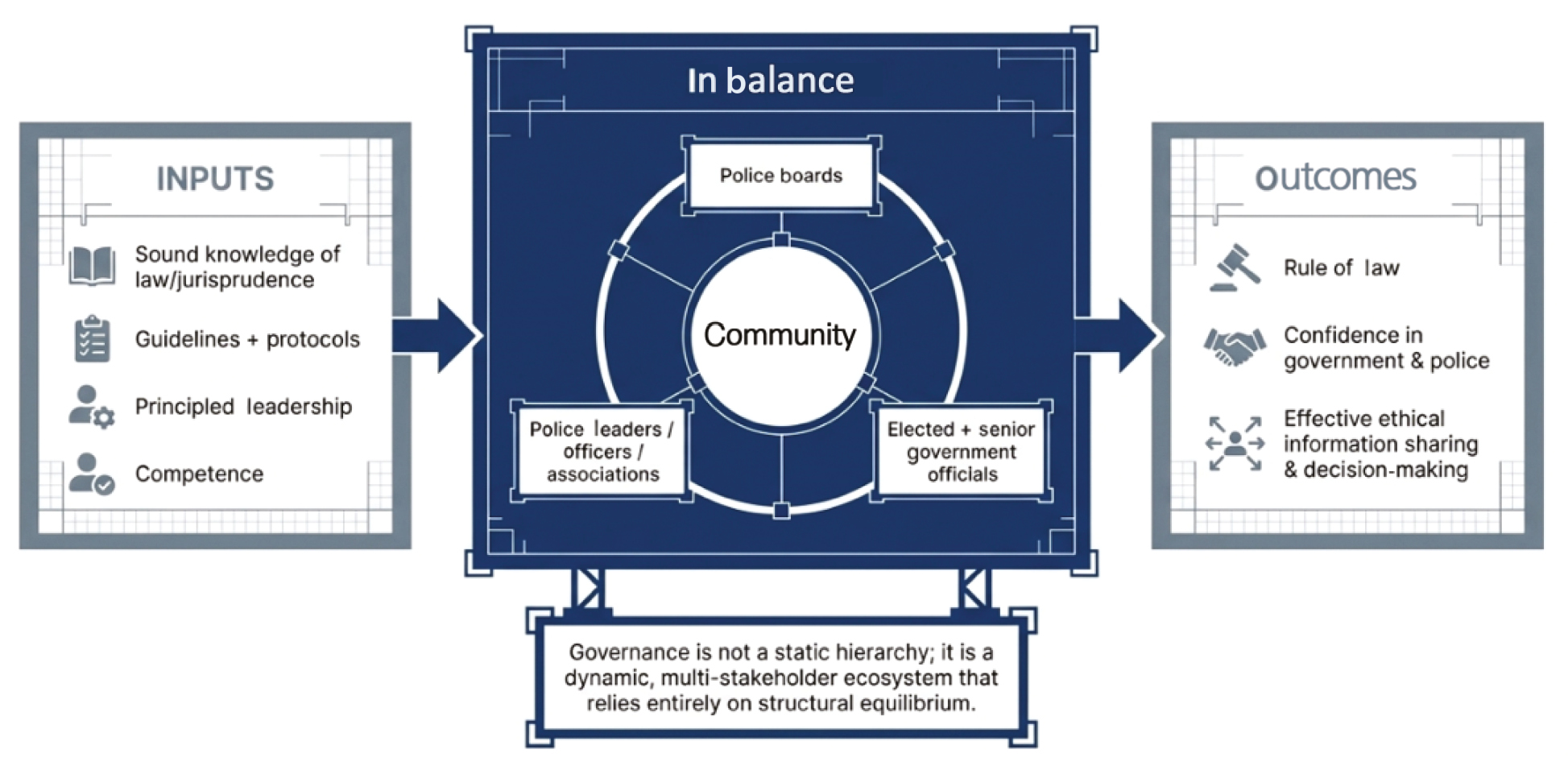
Police governance does not operate in isolation. It functions within what CSKA research describes as a “governance and accountability ecosystem” – a network encompassing police boards, police leaders, elected officials, and community stakeholders. As Figure 2 depicts, when this ecosystem is in balance it upholds the rule of law, fosters public trust, and promotes ethical decision-making; out of balance, it erodes confidence and creates conditions that enable misconduct (Corley et al., 2025; CSKA, 2023).
|
|
||
|
FIGURE 2 The governance and accountability ecosystem. Source: Adapted from Corley et al. (2025), with permission of the copyright holder(s). | ||
The structural shortfalls described above systematically knock this ecosystem out of balance, in the same direction every time. They consistently weaken the governing body relative to those being governed. A system in which the governed are structurally stronger than those governing them is not a governance system at all.
Recent major inquiries have confirmed this imbalance with striking consistency. The Rouleau Report and the Nova Scotia Mass Casualty Commission – echoing earlier inquiries (e.g., Epstein, 2021; Morden, 2012) – both documented widespread confusion across the ecosystem about the boundaries of operational independence, present across all constituencies: police, board members, public servants, and elected officials alike. Senior public servants reported being paralyzed with uncertainty, unsure what they could request from police and fearful of crossing a line no one could clearly articulate (CSKA, 2023).
As noted earlier, the 2014 CCA report anticipated exactly this trajectory, envisioning police boards evolving into more expansive “public security boards” with a much larger remit across the CSWB ecosystem (CCA, 2014, pp. 83–84, 146).
While that fully integrated CSWB future is not here yet, its demands are imminent. This raises a critical question: if boards already struggle to execute their current, limited mandate of overseeing the public police, how can they be prepared to take on additional responsibilities? Expecting structurally starved, flawed boards to adopt an expanded CSWB remit without first fixing their foundational deficits is a recipe for long-term governance failure.
“The board is net positive – like not that it isn’t a pain in the ass at times, but it’s net positive. If after George Floyd, if our (City) Council could have done something, I’ll call it stupid, they would have. But the reason they couldn’t do it was because of the police board.” (Chief of major Canadian police service (#2) – Interviewed, 2022)
As Roach (2023) observed, the way ahead requires shifts that uphold operational independence while clarifying its real objective, and correspondingly reframe what accountability looks like within it. The key distinction is between before-the-fact permission and after-the-fact accountability. Police do not need – and should not seek – board permission before specific operational decisions, as that would constitute precisely the political interference the doctrine is designed to prevent (R. v. Campbell, 1999; Roach, 2023). But police must be fully accountable for explaining those decisions, their outcomes, and their cultural implications to the board after the fact. The board’s role is not to pre-approve operations, but to ensure that operations, over time, reflect sound policy, ethical culture, and community values (Corley et al., 2025; Sinclair, 2018).
The absence of a permission requirement, however, must not be conflated with a prohibition on proactive consultation and dialogue between police and board. As Justice Morden (2012) observed in his G20 Summit review, the rigid separation of “policy” and “operations” into separate compartments is invalid and actively inhibits effective governance.
Morden concluded that an effective governance model requires a robust information exchange, with boards briefed on upcoming police operations in advance. This allows the board to help define the “what” of an operation – its objectives and priorities – while police retain absolute independence over the “how” of tactical execution.
The board can and should review significant operational plans in advance to ensure they align with existing policies, ethics, and community values, offering recommendations with the understanding that the chief retains ultimate authority to accept or reject them (Corley et al., 2025; Morden, 2012). Complementing this proactive engagement is after-the-fact accountability. While the police independently handle the tactical implementations of an event, they are fully accountable for explaining operational decisions, their outcomes, and their cultural implications to the board after the fact (Roach, 2023).
This concept – operational responsibility – is not a significant departure from existing jurisprudence, but a clarification of what responsible governance has always meant. Boards should never be passive rubber stamps; they are the legitimate democratic authority responsible for ensuring local policing is effective, efficient, and serves the community (Morden, 2012; Roach, 2022). That requires access to operational data, the confidence to ask hard questions, and the legal framework to enforce accountability (Corley et al., 2025; Roach, 2023).
Reform will require simultaneous action on all three cracks in the governance model. Half-measures on one dimension alone will not produce the durable change that has evaded this issue for years. Because these issues are rooted in deeply embedded cultural and professional dynamics as well as structural ones, reform must address not only how boards are designed, but the power imbalances and institutional behaviours that have taken hold within flawed structures.
Boards must transition toward a professional, skills-based model, with appointment processes governed by transparent, explicit competency matrices ensuring boards possess the expertise their mandate demands (e.g., financial, legal, strategic, community, and public health knowledge).
But technical competency alone is insufficient; attention must also go to the character, judgment, and governance “fit” of prospective board members. Effective governance depends not only on what members know, but on how they engage – their willingness to ask tough questions, exercise independent thinking, and hold firm under pressure. The Winnipeg Board’s matrix addresses this well, citing integrity, professionalism, collaboration, and understanding of the policing environment (Winnipeg Police Board, n.d.).
A board composed entirely of subject-matter experts but lacking the temperament for rigorous, principled oversight will be no more effective than one lacking expertise altogether.
Short, politically tied terms must be replaced with extended, staggered appointments that insulate governance from election cycles and allow deeper institutional knowledge to accumulate. As one Ontario police chief interviewed in 2022 put it, “Every time you get a new board member, you’ve got a new board. And so one of the challenges that police leaders, at least in our province, have is the turnover rate of boards.”
Continuity is central to good governance. Without it, boards remain in a constant state of inexperience, compounding the informational and know-how advantage already held by police executives.
“The strat plan is the board’s responsibility, but we have no resources. Like that is our business plan. And yet, when I joined the board, I was shocked when I looked at first business plan and it was signed by the chief of police. The problem with (the Board) taking it over was, quite simply that we had nobody to run it.” (Vice-Chair, major Canadian police board – Interviewed, 2022)
Statutory minimum funding standards are essential. Boards cannot effectively exercise their mandates without dedicated secretariat staff, independent legal counsel, and research capacity commensurate with the size and complexity of the service they oversee; relying on borrowed resources from those being governed impedes independence.
As noted earlier, police executive teams control the operational data and institutional knowledge boards depend on; without independent support capacity, boards are left responding to what the executive presents rather than proactively setting direction and holding the service to account.
The relationship between boards and police services must shift from deference to active, informed, and accountable engagement. This means codifying operational responsibility in provincial police legislation, establishing data rights, and crafting written policies that clearly delineate respective roles, responsibilities, and mutual expectations.
This broad shift must also address the cultural dynamic described earlier – the paramilitary orientation that can lead police leaders to act less as employees accountable to their board and more as independent agenda-setters. Reform must equip boards with the structural authority, independent resources, and professional development to engage police executives as confident, informed, and equal partners in governance – not as passive recipients of executive briefings.
“Policing never changes without a crisis. Well, we’ve got a crisis of (significant) proportions to leverage like hell for the next 3 to 5 years. So do that – leverage the hell out of it for the next 3 to 5 years.” (Former Chief of major Canadian police service (#4) – Interviewed, 2022)
Canadian policing is gradually entering the era of CSWB. This will require more of its governance institutions, not less. The changing nature of crime, emerging technologies, social complexity, and rising community expectations are among the trends shaping the policing environment – all requiring highly effective boards that are empowered, resourced, and structurally capable of the oversight they are asked to provide.
Today, we invite bright, public service-minded people to serve on boards and then deny them the tools and infrastructure they need to succeed. That is not fair to them, to the boards they sit on, or to anyone else in the wider governance and accountability ecosystem who depends on boards doing their job.
Until the issues described above are addressed – through legislative modernization, adequate resourcing, and reformed appointment processes – training alone simply cannot deliver the substantive governance boards and communities need. Boards still need strong, practical training, but it must be complementary to structural reform, not a substitute for it.
The status quo is no longer an option. Without appropriate structure and support systems, effective police governance relies purely on relationships – no substitute for accountability. We are long past the point of merely coping with a broken system – it is time to insist on a professional model that aligns with the complexity and stakes of modern policing.
Ultimately, strengthening civilian police governance is a pragmatic investment in all who depend on Canadian policing. Police leaders, board members, municipal and provincial officials, front-line officers, and the communities they serve all benefit when boards are structurally equipped to do the job legislation already expects of them. Aligning governance frameworks with the complexity and risks of contemporary policing should be a shared responsibility of everyone who cares about the legitimacy, effectiveness, and long-term sustainability of policing in Canada.
The reforms described above will require organized, sustained advocacy led provincially by police service board associations, or, where none exist, by a coalition of police service boards within the province. The Canadian Association of Police Governance (CAPG) is well positioned to provide coordinating and logistical support to these efforts.
The following recommendations are provided for the consideration of provincial police service board associations:
Recommendation #1: Build the coalition (within 12 months). Establish a permanent Governance Reform Working Group of willing boards to develop a common structural reform agenda and advocate for legislative amendments at the provincial level.
Recommendation #2: Develop model legislation (within 18 months). Create a model Police Governance Modernization Bill that codifies operational responsibility, mandates statutory minimum funding for board secretariats, and requires skills-based, staggered board appointments – a ready-made package that eases the path to ministry adoption.
Recommendation #3: Commission strategic case studies. Publish two to three case studies annually documenting how governance failures have constrained oversight, effective policing, and community safety outcomes, in support of evidence-informed advocacy.
Recommendation #4: Establish data/information rights protocols. Negotiate province-wide data and information protocols affirming boards’ right to operational data to support strategic governance. This principle must be codified, not left to the goodwill of individual police executives.
Recommendation #5: Create a competency-based appointment framework. Adapt the Winnipeg framework (or another established model) to give local governments and provinces a standardized competency matrix and urge that appointment processes align with it.
These recommendations are realistic, practical, and achievable within the existing Canadian governance landscape. They do not ask provinces or boards to become something they are not, but to use the tools they already have more deliberately and in concert.
Taken together, they begin to close the gap between what boards are legally responsible for and what they are equipped to do, turning scattered frustrations into a coherent, evidence-informed reform agenda backed by concrete model language governments can act on.
By strengthening the statutory footing of boards, securing predictable access to operational data and information, and professionalizing appointment practices, provincial associations can help boards become effective partners for chiefs and municipalities – and credible safeguards for communities.
This will require sustained, coordinated effort over several years, with provincial associations – ideally supported by CAPG, the Canadian Association of Chiefs of Police, and the Canadian Police Association – keeping these priorities on the table through shifting political cycles and leadership changes, until a modern governance framework is no longer aspirational but simply how policing is done in Canada.
None.
The author has no conflicts of interest to declare.
None.
None.
∗Community Safety Knowledge Alliance (CSKA), Toronto, ON, Canada.
Aust, E. A., & Aust, T. L. (2013). Reflections on police independence, governance and evolution. Presentation to the Canadian Association of Police Boards Annual Conference, Saskatoon, SK, 15 August 2013.
Canadian Municipal Network on Crime Prevention (CMNCP). (2020). Practitioner guide on crime prevention and community safety and well-being. https://ccfsc-cccs.ca/wp-content/uploads/2024/01/CMNCP-Practitioner-Guide-on-CP-CSWB-Final-2020.pdf
City of Ottawa, Office of the Auditor General. (2023). Audit of the Ottawa Police Service’s response to the convoy protest – The role of the Ottawa Police Services Board. February 2023. https://www.oagottawa.ca/media/bkddxumx/audit-of-the-ottawa-police-service-s-response-to-the-convoy-protest-the-role-of-the-ottawa-police-services-board-report.pdf
Corley, C., Reber, M., & Linden, R. (2025). Police operational independence and the rule of law in Canada: Improving police governance and accountability. Journal of Community Safety and Well-Being, 10(1), 11–19. https://doi.org/10.35502/jcswb.440 [CrossRef]
Council of Canadian Academies. (2014). Policing Canada in the 21st Century: New Policing for New Challenges. The Expert Panel on the Future of Canadian Policing Models, Council of Canadian Academies, Ottawa, ON.
CSKA. (2023). Police operational independence and the rule of law: Improving police governance and accountability. Community Safety Knowledge Alliance (CSKA), May 2023. https://cskacanada.ca/wp-content/uploads/2024/06/Police-Operational-Independence-FINAL-2024-04-27.pdf
Epstein, G. J. (2021). Missing and missed: Report of the independent civilian review into missing person investigations. Independent Civilian Review into Missing Person Investigations for the Toronto Police Service Board, 13 April 2021. https://www.tps.ca/chief/chiefs-office/missing-and-missed-implementation/report-independent-civilian-review-missing-person-investigations/
Graham, A. (2018). The concept of governance as forward oversight as applied to police agencies in Canadian municipalities. Paper prepared for the XXII International Research Society for Public management Annual Conference, April 2018. https://www.mmiwg-ffada.ca/wp-content/uploads/2018/06/P02P02P0101_Regina_Exh_18_Bellegarde.pdf
Hodgkinson, T., Caputo, T., & Martino, N. (2023). The governance gap: Examining the capacity of police service boards to hold police services accountable in Canada. Police Practice and Research, 25(4), 437–454. https://doi.org/10.1080/15614263.2023.2281999 [CrossRef]
Independent Expert Panel to the Thunder Bay Police Services Board. (2023). Building trust through bold action: Roadmap for real change. Thunder Bay, Ontario, April 2023. https://www.hamiltonpsb.ca/media/p3ifwodv/independent-expert-panel-final-report-april-13-2023-1.pdf
Kelcey, B. (2022). Ottawa’s police board crisis is just the tip of Canada’s police-governance problem. Globe and Mail, 14 March 2022. https://www.theglobeandmail.com/opinion/article-ottawas-police-board-crisis-is-just-the-tip-of-canadas-police/
Laming, E., & Valentine, G. (2022). Police governance in Canada: Variations and disparities among police service boards. Canadian Public Administration, 65(1), 7–27. https://doi.org/10.1111/capa.12448 [CrossRef]
Morden, J. W. (2012). Independent civilian review into matters relating to the G20 Summit, June 2012. https://aapg.ca/wp-content/uploads/2025/05/2012-Morden-report.pdf
Murphy, C. & McKenna, P. (2007). Rethinking police governance & management. Prepared for the Task Force on Governance and Cultural Change in the RCMP, Public Safety Canada. https://www.publicsafety.gc.ca/lbrr/archives/hv%208158%20m8r%202007-eng.pdf
R. v. Campbell, [1999] CanLII 676 (SCC), 1 SCR 565. https://scc-csc.lexum.com/scc-csc/scc-csc/en/item/1692/index.doc
Roach, K. (2022). Canadian policing: Why and how it must change. Delve Books. 274 pp.
Roach, K. (2023). The dangers of police “operational” independence. Manitoba Law Journal, 46(1), 53–67. https://doi.org/10.29173/mlj1436 [CrossRef]
Rouleau, P. S. (2023). Report of the public inquiry into the 2022 public order emergency, Ottawa, ON. https://publicorderemergencycommission.ca/final-report/
Sears, R. V. (2022). The situation in Ottawa shows our police governance is broken. Toronto Star, 20 February 2022. https://www.thestar.com/opinion/contributors/the-situation-in-ottawa-shows-our-police-governance-is-broken/article_9993e60d-8894-5fb9-9cda-042e2c9120c3.html
Sinclair, M. (2018). Thunder Bay Police Services Board investigation: Final report, 01 November 2018. Submission to the Safety, Licensing, Appeals and Standard Tribunals Ontario. https://tribunalsontario.ca/documents/ocpc/TBPSB_Investigation_Final_Report_-_EN-FINAL-1.pdf
Stenning, P. (2021). Police chiefs and their political bosses: Discussions in Ontario. Policing, 15(1), 150–167. https://doi.org/10.1093/police/pay062 [CrossRef]
Winnipeg Police Board. (n.d.). Competencies and attributes recommended for members of the Winnipeg Police Board. https://legacy.winnipeg.ca/clerks/boards/WpgPoliceBoard/pdfs/BoardMemberCompetencies.pdf
*Correspondence to: Cal Corley, Community Safety Knowledge Alliance (CSKA), Port Rowan, ON, N0E 1M0, Canada. Telephone: 613-297-6728. E-mail: ccorley@cskacanada.ca
This work is distributed under the Creative Commons BY-NC-ND license. To view a copy of this license, visit http://creativecommons.org/licenses/by-nc-nd/4.0/. For commercial re-use, please contact sales@sgpublishing.ca.
Journal of CSWB, VOLUME 11, NUMBER 3, September 2026