, Colette Severin†, Shireen Harbin†, Megan Edgelow‡, Emma Irvin†, Pam Cardwell†, Andrea D. Furlan†¶
| Journal of Community Safety and Well-Being (2026) 11(3), 106–112. | https://doi.org/10.35502/jcswb.532 |
Nadia Aleem∗, Colette Severin†, Shireen Harbin†, Megan Edgelow‡, Emma Irvin†, Pam Cardwell†, Andrea D. Furlan†¶
ABSTRACT
Mental health concerns caused by and/or exacerbated by work are common among public safety personnel (PSP). Healthcare providers (HCPs) generally receive very little support to help understand and address the impact that workplace strain has on PSP mental health and occupational functioning, which may limit PSP engagement and quality of care. This study aimed to develop, implement, and evaluate a multimodal educational program to help HCPs better support the unique mental health concerns of PSP. We followed the Extensions for Community Healthcare Outcomes (ECHO) model to provide HCPs with an opportunity to learn about PSP-specific workplace demands, culture, and occupational resources. We employed an observational pre-post study design to assess participants’ changes in self-efficacy, knowledge, and connection to community supports. From September 2023 to June 2024, two cycles of 12 virtual ECHO sessions were delivered. A total of 346 HCPs from diverse clinical backgrounds registered for the program, with 71.4% attending at least one session. One hundred and nine participants completed both pre- and post-ECHO questionnaires. Ninety-six percent of respondents reported satisfaction with the ECHO program. Statistically significant increases in participant self-efficacy, knowledge, and connection with community supports were reported. In conclusion, our study demonstrated high levels of participant acceptability and satisfaction alongside improved rates of self-efficacy, knowledge, and connection to resources to support the mental health and occupational functioning of PSP. There is a need to better understand how to optimize engagement in this program and explore expanded participation modeling with goals of better supporting occupational health outcomes for PSP and potentially across sectors.
Key Words Education, mental health, healthcare providers, public safety personnel.
Public safety personnel (PSP) experience substantially higher rates of mental health conditions than the general population because of repeated exposure to occupational stressors and potentially traumatic events (Carleton et al., 2018; Edgelow et al., 2023a, b; Nisbet et al., 2023). Healthcare providers (HCPs) play a critical role in supporting PSP recovery, yet many receive little formal education on the influence of PSP workplace culture, occupational demands, and compensation systems on mental health care (Edgelow et al., 2022, 2024; Furlan et al., 2022). This educational gap may limit access to professional culturally competent, evidence-informed care and negatively affect both clinical and occupational outcomes.
HCPs currently develop PSP-specific expertise through continuing education, clinical supervision, and direct clinical experience. Although educational resources such as PSPNet (www.pspnet.ca), CIPSRT (www.cipsrt-icrtsp.ca), and PSP-focused trauma programs (www.woundedwarriors.ca) improve foundational knowledge, they are largely didactic and may be insufficient to produce sustained changes in clinical practice. Similarly, access to experienced supervisors with expertise in PSP mental health is limited, while learning through clinical experience alone is slow and inconsistent.
Tele-mentoring has emerged as an effective approach to improving HCP knowledge, confidence, and clinical practice through case-based learning and expert mentorship. Project ECHO (The Extensions for Community Healthcare Outcomes) is a well-established tele-mentoring model that combines brief didactic teaching with multidisciplinary case consultation and has demonstrated effectiveness across numerous healthcare settings (Arora et al., 2011; Furlan et al., 2019; McBain et al., 2019).
To address the need for accessible PSP-specific education, we developed ECHO PSP, a 12-week tele-mentoring program combining clinical and workplace cultural competency education with case-based consultation. This pilot study evaluated the feasibility and educational impact of the program by examining participant acceptability and satisfaction, self-efficacy, knowledge acquisition, and beliefs and attitudes toward PSP mental healthcare—domains recognized as important determinants of HCP behaviour change (Engl et al., 2019; Mather et al., 2022; Sales et al., 2022).
ECHO PSP was developed in 2022 through a 2-year pilot grant from Ontario’s Workplace Safety and Insurance Board (WSIB). WSIB provided funding but had no role in analysis, interpretation, or evaluation of the program. The program was implemented according to recommendations from the ECHO Institute and ECHO Ontario Superhub and received approval from the Research Ethics Board of the University of Toronto (protocol 40747). Participants were not offered a direct connection to WSIB benefits or support through enrollment.
An advisory committee comprising PSP members, researchers, clinicians, employer and professional associations, and WSIB representatives provided guidance on curriculum development, participant recruitment, and knowledge translation. A multidisciplinary Expert Hub comprising 12 members was established, including HCPs with expertise in PSP mental health, PSP members with lived experience, Indigenous policing representatives, and employer and WSIB representatives. Expert Hub members participated in all ECHO sessions, providing case consultation and educational support.
The ECHO PSP program consisted of 12 weekly videoconference sessions incorporating a brief didactic presentation, participant-led de-identified case discussion, and multidisciplinary consultation from the Expert Hub. All cases were reviewed before presentation to ensure clinical relevance and protection of patient confidentiality. Session summaries and recordings were made available through a secure website for asynchronous learning. Participants completing at least seven sessions received continuing education certification.
The 12-session didactic curriculum was developed from the literature, expert consensus, and a needs assessment survey completed by 169 respondents recruited through professional and social media networks. Identified priority topics included PSP workplace culture, operational stress injuries, evidence-based post-traumatic stress disorder (PTSD) treatment, return-to-work planning, and available occupational and healthcare resources. These topics informed both program content and evaluation outcomes.
HCPs with experience or interest in caring for PSP (paramedics, police, correctional workers, firefighters, and emergency communications personnel) were recruited through professional organizations, ECHO networks, WSIB, and social media.
Participants were invited to submit de-identified clinical cases for multidisciplinary discussion. Cases were reviewed by the program coordinator and principal investigators to ensure clinical relevance and removal of identifying information. Presenters were encouraged to obtain patient consent before case presentation, and confidentiality requirements were reviewed immediately before each session. Cases were limited to working-age Ontario PSP with work-related mental health conditions.
Following each session, participants received a written summary of recommendations and relevant resources. Session recordings and materials were made available through a secure online repository for asynchronous access. The program was accredited for continuing education, and participants attending at least seven sessions received a certificate of completion. The ECHO PSP Program was delivered at no cost to participants.
Participant demographic information collected at registration included profession, years of practice, practice location, and proportion of PSP within participants’ clinical caseload.
Program outcomes were evaluated using a pre-post design with questionnaires adapted from standard Project ECHO evaluation instruments and administered through Qualtrics™. Attendance was recorded using Zoom™ reports.
Outcome measures included:
Likert responses ranged from 1 (strongly disagree) to 5 (strongly agree), with responses of 4 or 5 classified as positive.
Participants attending at least one session were classified as program participants. Those completing both pre- and post-program questionnaires were included in the outcome analyses. A total of 109 participants (31.5%) completed both pre- and post-program questionnaires and were included in the outcome analyses.
Self-efficacy and knowledge scores were compared before and after program participation and between high-attendance (≥7 sessions) and low-attendance (≤6 sessions) groups. Repeated-measures analysis of variance was used to assess changes over time and differences by attendance. Statistical analyses were performed using SAS version 9 (SAS Institute Inc., Cary, NC, USA).
Across two ECHO PSP cycles, 360 HCPs registered for the program. Of these, 249 participants (69%) attended at least one session, while the remaining 31% did not attend. High attendance (≥7 sessions) was achieved by 149 participants (41%).
Participants were primarily psychologists, psychotherapists, occupational therapists, and social workers practicing in community-based urban or suburban settings. Most had more than 10 years of clinical experience. PSP comprised a mean of 44.1% (standard deviation = 29.7) of participants’ clinical caseloads, with approximately 20% reporting that PSP represented at least 75% of their practice. Participant characteristics were comparable between high- and low-attendance groups (Table I).
TABLE I Registrant and high-rate participant occupational demographics
| Registrants Cycles 1 and 2 n = 346 (%) |
High-Rate Participants Cycles 1 and 2 n = 149 (%) |
||
|---|---|---|---|
| Primary profession | |||
| Psychologist | 53 (15.3%) | 21 (14.1%) | |
| Occupational therapist | 78 (22.5%) | 46 (30.9%) | |
| Psychotherapist | 92 (26.6%) | 37 (24.8%) | |
| Social worker | 48 (13.9%) | 18 (12.1%) | |
| Family physician | 6 (1.7%) | 3 (2%) | |
| MD specialist | 4 (1.2%) | 2 (1.3%) | |
| Nurse practitioner | 7 (2%) | 2 (1.3%) | |
| Registered nurse | 11 (3.2%) | 4 (2.7%) | |
| Physiotherapist | 1 (0.3%) | 1 (0.7%) | |
| Kinesiologist | 3 (0.9%) | 0 | |
| Chiropractor | 6 (1.7%) | 0 | |
| Massage therapist | 4 (1.2%) | 1 (0.7%) | |
| Student | 17 (4.9%) | 5 (3.4%) | |
| Other | 16 (4.6%) | 9 (6%) | |
| Years of practice | |||
| 21 (6%) | 7 (4.7%) | ||
| 1–4 years | 73 (21.1%) | 33 (22.1%) | |
| 5–10 years | 78 (22.5%) | 31 (20.8%) | |
| 168 (48.6%) | 75 (50.3%) | ||
| Other | 6 (1.7%) | 3 (2%) | |
| Location of practice | |||
| Suburban/urban | 155 (44.7%) | 67 (45%) | |
| Rural/remote | 40 (12.2%) | 20 (13%) | |
| Underserviced | 3 (0.8%) | 0 | |
| Virtual | 5 (1.4%) | 2 (1%) | |
| Combination | 131 (37.9%) | 54 (36%) | |
| Other | 12 (3.5%) | 6 (4%) | |
| Work environment | |||
| Community practice | Private practice | 125 | 93 (62%) |
| Health centre or family health team | 7 () | 3 (2%) | |
| Hospital practice | Outpatient | 6 (1.7%) | 3 (2%) |
| Inpatient | 7 (2%) | 2 (1.3%) | |
| Academic hospital | 3 (0.9%) | 1 (0.7%) | |
| Non-academic hospital | 3 (0.9%) | 0 | |
| WSIB affiliate | Community mental health program | 25 (7.2%) | 13 (8.7%) |
| Specialty clinic | 12 (3.5%) | 4 (2.7%) | |
| Other WSIB program | 6 (1.7%) | 4 (2.7%) | |
| Other | 52 (14.5%) | 23 (15.4%) |
WSIB = Workplace Safety and Insurance Board.
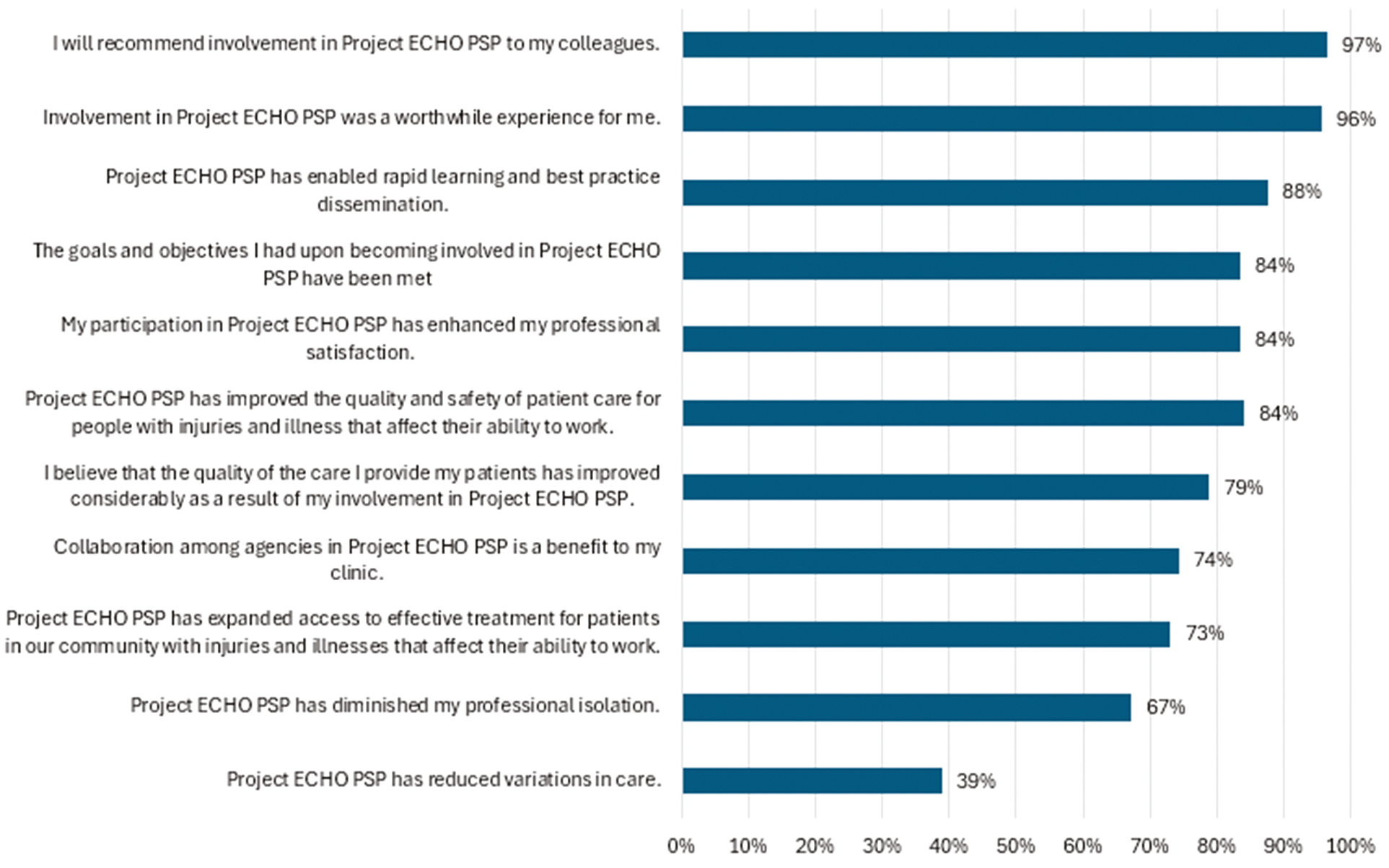
Program acceptability and satisfaction were high across all measured domains (Figure 1). More than 96% of respondents reported that participation was worthwhile and would recommend the program to colleagues. Over 88% agreed that the program improved the quality of care they provide, accelerated learning, and supported implementation of evidence-informed practice. Approximately three-quarters also reported increased understanding of interagency collaboration and reduced professional isolation.
|
|
||
|
FIGURE 1 Percentage of participants who selected agree/strongly agree on the 11-item Acceptability and Satisfaction with ECHO PSP scale ( | ||
Mean self-efficacy scores increased significantly following program participation (F(1,107) = 172.90, p < 0.0001). Improvements did not differ between participants with high (≥7 sessions) and low (≤6 sessions) attendance (F(1,107) = 0.317, p > 0.05) (Table II).
TABLE II Self-efficacy mean score difference between session groups pre- and post-ECHO
| ECHO Participants’ Attendance at ≥7 versus ≤6 Sessions | n | Pre-ECHO Self-efficacy Score Mean (SD) |
Post-ECHO Self-efficacy Score Mean (SD) |
|---|---|---|---|
| ≥7 sessions | 92 | 3.50 (0.49) | 4.29 (0.41) |
| <7 sessions | 17 | 3.34 (0.54) | 4.18 (0.43) |
| Whole sub-sample | 109 | 3.46 (0.51) | 4.26 (0.41) |
ECHO = Extensions for Community Healthcare Outcomes; SD = standard deviation.
Participants demonstrated significant positive changes in attitudes toward the importance of PSP workplace cultural competence, interdisciplinary care, peer support programs, and workers’ compensation resources in supporting recovery and return to work. Baseline agreement regarding the influence of workplace culture on recovery, the potential for return to work following PTSD, and the absence of a single optimal PTSD treatment approach was high and did not change following the program.
Knowledge acquisition scores increased significantly from pre- to post-program (F(1,104) = 17.22, p < 0.001). Improvements were similar between high- and low-attendance groups, with no significant attendance-by-time interaction (F(1,104) = 0.00, p > 0.05) (Table III).
TABLE III Knowledge mean score difference between session groups pre- and post-ECHO
| ECHO Participants’ Attendance at ≥7 versus ≤6 Sessions | n | Pre-ECHO Knowledge Score Mean (SD) | Post-ECHO Knowledge Score Mean (SD) |
|---|---|---|---|
| ≥7 sessions | 92 | 19.62 (2.03) | 20.83 (2.22) |
| <7 sessions | 17 | 19.73 (1.78) | 20.46 (2.02) |
| Whole sub-sample | 109 | 19.65 (1.97) | 20.74 (2.17) |
ECHO = Extensions for Community Healthcare Outcomes; SD = standard deviation.
This pilot study evaluated the feasibility and educational impact of ECHO PSP using implementation science principles and behavioural change constructs derived from the Theoretical Domains Framework (TDF) (Atkins et al., 2017; Cane et al., 2012). Overall, participants reported high program acceptability and satisfaction, significant improvements in self-efficacy and knowledge, and positive changes in attitudes toward culturally competent, interdisciplinary care for PSP. Together, these findings suggest that ECHO PSP is a feasible model for supporting continuing professional development in PSP mental healthcare.
High levels of participant satisfaction indicate that the program was perceived as relevant, practical, and valuable. Acceptability is a key determinant of successful implementation and sustainability, as educational interventions are more likely to influence practice when participants perceive them as useful and applicable (Garone et al., 2022; Kirkpatrick & Kirkpatrick, 2006). The strong satisfaction ratings observed across multiple domains support the suitability of the ECHO model for delivering accessible, workplace-focused education to HCPs caring for PSP.
Participants also demonstrated significant improvements in perceived self-efficacy regardless of attendance level. Self-efficacy, generally defined as an HCP’s confidence to deliver a specific healthcare practice, is an established predictor of HCP behaviour and implementation of evidence-informed practice (Shapiro et al., 2021). The observed improvements suggest that ECHO PSP may increase clinicians’ confidence in assessing and managing work-related mental health conditions among PSP with a greater understanding of the context in which these illnesses occur and the resources that can be utilized. Namely, there were noted improvements in self-efficacy related to increased awareness of occupational resources, including interdisciplinary services, peer support programs, and workers’ compensation systems. This further supports the program’s aim of improving providers’ understanding of the broader systems involved in PSP recovery and return to work. Similarly, significant gains in knowledge indicate that the program successfully achieved its educational objectives in improving participants’ knowledge acquisition in topics deemed most relevant to healthcare provision for PSP, as determined through preliminary survey needs assessment data.
Changes in participant attitudes and beliefs provide additional evidence of the program’s potential to influence future clinical practice. Positive attitudes and beliefs with respect to healthcare delivery implementation are primary drivers of behavioural intention and change (Galloway, 2003; Kalamar et al., 2023). Following participation, respondents reported greater recognition of the importance of PSP workplace cultural competence awareness in PSP care provision. They additionally reported increased appreciation of interdisciplinary care, peer support, and workers’ compensation clinical and occupational resources. These domains represent important determinants of clinician behaviour and align closely with the intended objectives of the program.
Several limitations should be considered when interpreting these findings. First, questionnaire outcomes were based on participants who completed both pre- and post-program evaluations (31.5% of participants). Because non-attenders and non-responders were not represented, satisfaction and acceptability may be overestimated due to selection bias. Future evaluations should investigate barriers to participation and incorporate strategies to capture the perspectives of participants who disengage from the program.
Second, participants demonstrated high baseline awareness of the relationship between PSP workplace culture and mental health, limiting the opportunity to detect change in this domain. The participant cohort consisted predominantly of experienced community-based clinicians with substantial PSP caseloads, suggesting that the program successfully attracted providers already interested in this area. Conversely, primary care clinicians and specialist physicians were underrepresented despite their important role in delivering mental healthcare to PSP.
Finally, knowledge assessments evaluated learning derived from the didactic curriculum but did not measure knowledge gained through case-based discussions, thus missing evaluation of knowledge acquisition resulting from a central feature of the ECHO model. The study equally missed measurement of engagement and evaluation of outcome measurements resulting from access to asynchronous online resources. Finally, the study also did not assess long-term participant knowledge retention and application, thus resulting in the absence of understanding of changes in clinical practice and patient-level outcomes.
Future research should evaluate the long-term impact of ECHO PSP on clinician behaviour, patient outcomes, and healthcare system performance using implementation science frameworks. Recruitment strategies should also be expanded to improve participation among primary care providers and other underrepresented professional groups. The finding that improvements in self-efficacy and knowledge were comparable between high- and low-attendance participants suggests that shorter or more flexible program formats may achieve similar educational benefits while improving accessibility and retention. Given the positive findings observed in this pilot, adaptation of the ECHO PSP model for other occupations with elevated rates of work-related psychological injury, including military personnel and healthcare workers, also warrants investigation.
ECHO PSP was a feasible and well-accepted continuing professional education program for HCPs working with PSP. Participation was associated with significant improvements in self-efficacy, knowledge, and attitudes toward evidence-informed, culturally competent PSP mental healthcare. These findings support the potential of the Project ECHO model to strengthen workforce capacity in PSP mental health care delivery, which in turn could support improved PSP engagement in treatment, thereby improving recovery and occupational outcomes. The evaluation results of this program provide a strong rationale for future studies examining its impact on the quality of HCPs’ clinical practice, as well as PSP mental health treatment engagement, recovery, and occupational outcomes.
We are grateful to WSIB for funding this pilot evaluation of ECHO PSP.
This program and research were funded by the Workplace Safety and Insurance Board (WSIB) research grants #FURL2020.
Andrea Furlan is a member of the WSIB Drug and Technology Advisory Committee and the Health Advisory Committee. Nadia Aleem provides clinical care within WSIB Mental Health Specialty programs.
This study was approved by the University of Toronto Research Ethics Committee.
∗Department of Psychiatry, University of Toronto, Toronto, ON, Canada;
†Institute for Work & Health, Toronto, ON, Canada;
‡School of Rehabilitation Therapy, Queen’s University, Kingston, ON, Canada;
¶Department of Medicine, University of Toronto, Toronto, ON, Canada.
Arora, S., Thornton, K., Murata, G., Deming, P., Kalishman, S., Dion, D., Parish, B., Burke, T., Pak, W., Dunkelberg, J., Kistin, M., Brown, J., Jenkusky, S., Komaromy, M., & Qualls, C. (2011). Outcomes of treatment for hepatitis C virus infection by primary care providers. New England Journal of Medicine, 364(23), 2199–2207. https://doi.org/10.1056/NEJMoa1009370 [CrossRef] [PubMed]
Atkins, L., Francis, J., Islam, R., O’Connor, D., Patey, A., Ivers, N., Foy, R., Duncan, E. M., Colquhoun, H., Grimshaw, J. M., Lawton, R., & Michie, S. (2017). A guide to using the Theoretical Domains Framework of behaviour change to investigate implementation problems. Implementation Science: IS, 12(1), 77. https://doi.org/10.1186/s13012-017-0605-9 [CrossRef] [PubMed]
Cane, J., O’Connor, D., & Michie, S. (2012). Validation of the theoretical domains framework for use in behaviour change and implementation research. Implementation Science: IS, 7, 37. https://doi.org/10.1186/1748-5908-7-37 [CrossRef] [PubMed]
Carleton, R. N., Afifi, T. O., Turner, S., Taillieu, T., Duranceau, S., LeBouthillier, D. M., Sareen, J., Ricciardelli, R., MacPhee, R. S., Groll, D., Hozempa, K., Brunet, A., Weekes, J. R., Griffiths, C. T., Abrams, K. J., Jones, N. A., Beshai, S., Cramm, H. A., Dobson, K. S., … Asmundson, G. J. G. (2018). Mental disorder symptoms among public safety personnel in Canada. Canadian Journal of Psychiatry, 63(1), 54–64. https://doi.org/10.1177/0706743717723825 [CrossRef] [PubMed]
Edgelow, M., Scholefield, E., McPherson, M., Legassick, K., & Novecosky, J. (2022). Organizational factors and their impact on mental health in public safety organizations. International Journal of Environmental Research and Public Health, 19(21), 13993. https://doi.org/10.3390/ijerph192113993 [CrossRef] [PubMed]
Edgelow, M., Fecica, A., Kohlen, C., & Tandal, K. (2023a). Mental health of public safety personnel: Developing a model of operational, organizational, and personal factors in public safety organizations. Frontiers in Public Health, 11, 1140983. https://doi.org/10.3389/fpubh.2023.1140983 [CrossRef] [PubMed]
Edgelow, M., Legassick, K., Novecosky, J., & Fecica, A. (2023b). Return to work experiences of Ontario public safety personnel with work-related psychological injuries. Journal of Occupational Rehabilitation, 33(4), 796–807. https://doi.org/10.1007/s10926-023-10114-6 [CrossRef] [PubMed]
Edgelow, M., Petrovic, A., Gaherty, C., & Fecica, A. (2024). Occupational therapy and public safety personnel: Return to work practices and experiences. Canadian Journal of Occupational Therapy, 91(2), 124–135. https://doi.org/10.1177/00084174231222075 [CrossRef] [PubMed]
Engl, E., Kretschmer, S., Jain, M., Sharma, S., Prasad, R., Ramesh, B. M., Shetye, M., Tandon, S., Kumar, S., Barrios Wilson, T., & Sgaier, S. K. (2019). Categorizing and assessing comprehensive drivers of provider behavior for optimizing quality of health care. PLOS ONE, 14(4), e0214922. https://doi.org/10.1371/journal.pone.0214922 [CrossRef] [PubMed]
Furlan, A. D., Zhao, J., Voth, J., Hassan, S., Dubin, R., Stinson, J. N., Jaglal, S., Fabico, R., Smith, A. J., Taenzer, P., & Flannery, J. F. (2019). Evaluation of an innovative tele-education intervention in chronic pain management for primary care clinicians practicing in underserved areas. Journal of Telemedicine and Telecare, 25(8), 484–492. https://doi.org/10.1177/1357633X18782090 [CrossRef] [PubMed]
Furlan, A. D., Harbin, S., Vieira, F. F., Irvin, E., Severin, C. N., Nowrouzi-Kia, B., Tiong, M., & Adisesh, A. (2022). Primary care physicians’ learning needs in returning ill or injured workers to work. A scoping review. Journal of Occupational Rehabilitation, 32(4), 591–619. https://doi.org/10.1007/s10926-022-10043-w [CrossRef] [PubMed]
Galloway R. D. (2003). Health promotion: Causes, beliefs and measurements. Clinical Medicine & Research, 1(3), 249–258. https://doi.org/10.3121/cmr.1.3.249 [CrossRef] [PubMed]
Garone, A., Bruggeman, B., Philipsen, B., Pynoo, B., Tondeur, J., & Struyven, K. (2022). Evaluating professional development for blended learning in higher education: A synthesis of qualitative evidence. Education and Information Technologies, 27(6), 7599–7628. https://doi.org/10.1007/s10639-022-10928-6 [CrossRef] [PubMed]
Kalamar, A., Oyedokun-Adebagbo, F., & Reichenbach, L. (2023). Advancing our understanding of provider behavior change for improved health outcomes. Global Health, Science and Practice, 11(Suppl 1), e2300314. https://doi.org/10.9745/GHSP-D-23-00314 [CrossRef] [PubMed]
Kirkpatrick, D. L., & Kirkpatrick, J. D. (2006). Evaluating training programs: The four levels. Berrett-Koehler Publishers.
Mather, M., Pettigrew, L. M., & Navaratnam, S. (2022). Barriers and facilitators to clinical behaviour change by primary care practitioners: A theory-informed systematic review of reviews using the Theoretical Domains Framework and Behaviour Change Wheel. Systematic Reviews, 11(1), 180. https://doi.org/10.1186/s13643-022-02030-2 [CrossRef] [PubMed]
McBain, R. K., Sousa, J. L., Rose, A. J., Baxi, S. M., Faherty, L. J., Taplin, C., Chappel, A., & Fischer, S. H. (2019). Impact of Project ECHO models of medical tele-education: A systematic review. Journal of General Internal Medicine, 34(12), 2842–2857. https://doi.org/10.1007/s11606-019-05291-1 [CrossRef] [PubMed]
Nisbet, J., Jamshidi, L., Andrews, K. L., Stewart, S. H., Shields, R. E., Teckchandani, T. A., Maguire, K. Q., & Carleton, R. N. (2023). Mental health and social support among Royal Canadian Mounted Police cadets. Frontiers in Psychology, 14, 1092334. https://doi.org/10.3389/fpsyg.2023.1092334 [CrossRef] [PubMed]
Sales, A. E., Farr, S. L., & Spertus, J. A. (2022). The influence of health behavior theory on implementation practice and science: Brief review and commentary. Pharmacy (Basel, Switzerland), 10(5), 115. https://doi.org/10.3390/pharmacy10050115’ [CrossRef]
Shapiro, C. J., Watson MacDonell, K., & Moran, M. (2021). Provider self-efficacy in delivering evidence-based psychosocial interventions: A scoping review. Implementation Research and Practice, 2, 2633489520988258. https://doi.org/10.1177/2633489520988258 [CrossRef] [PubMed]
*Correspondence to: Nadia Aleem, Trillium Health Partners. 2381 Bristol Circle, Suite 102, Door D, Oakville, ON L6H 5S9, Canada. Telephone: 905-813-4187. E-mail: nadia.aleem@thp.ca; Andrea D. Furlan, 400 University Avenue, Suite 1800, Toronto, ON M5G 1S5, Canada. Telephone: +1-416-597-3422 extension 4607. E-mail: andrea.furlan@utoronto.ca
This work is distributed under the Creative Commons BY-NC-ND license. To view a copy of this license, visit http://creativecommons.org/licenses/by-nc-nd/4.0/. For commercial re-use, please contact sales@sgpublishing.ca.
Journal of CSWB, VOLUME 11, NUMBER 3, September 2026