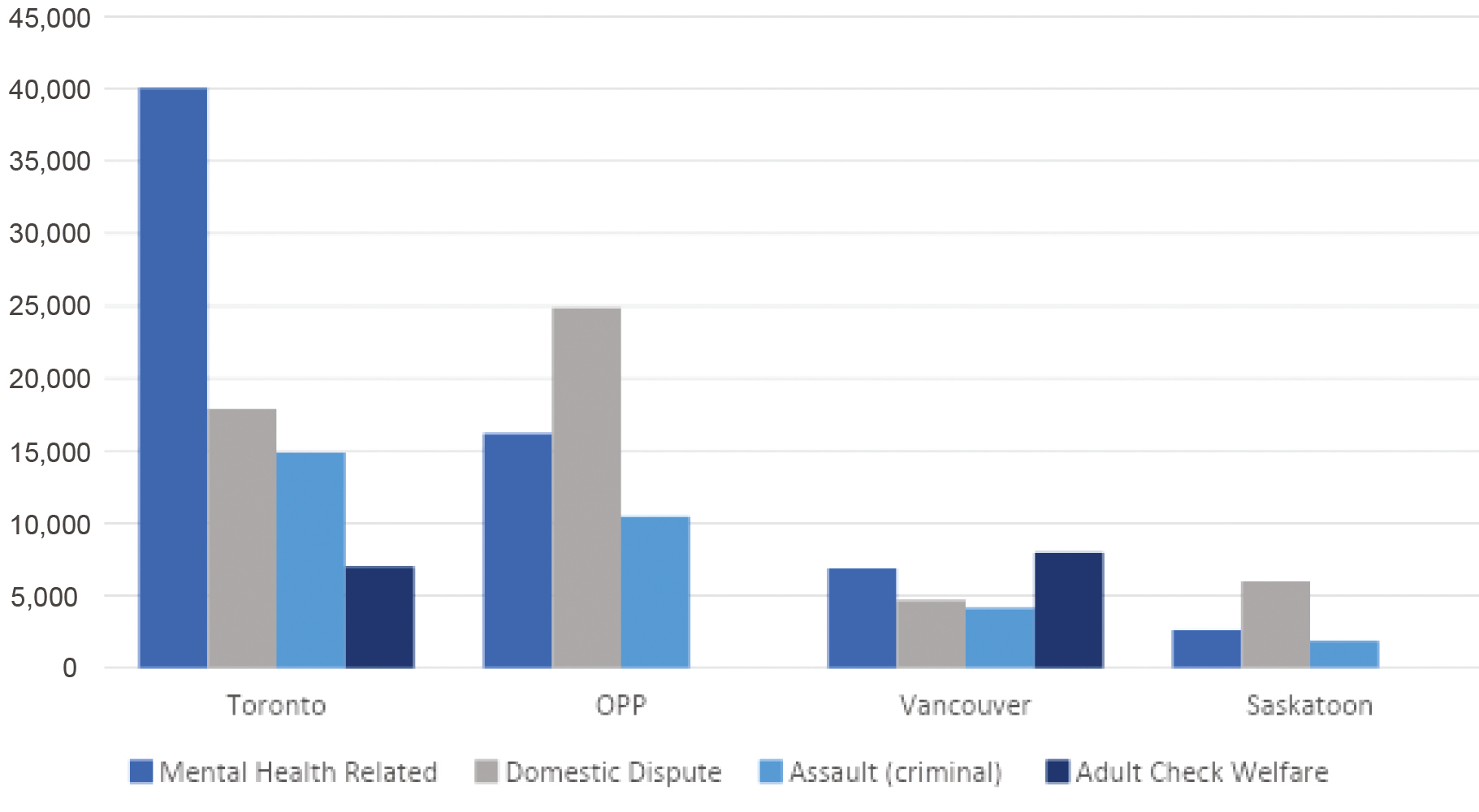
FIGURE 1 Selected police services calls for service in 2019. OPP, Ontario Provincial Police.
| Journal of Community Safety and Well-Being (2025) 10(4), 232–242. | https://doi.org/10.35502/jcswb.470 |
Lisa M. Deveau∗, Rebecca Stroud∗, Annette Jubril†, Maykal Bailey‡
ABSTRACT
The following social innovation narrative uses secondary data analysis released by Statistics Canada to explore the most frequent service calls responded to by police officers. To date, there is a lack of research comparatively exploring service calls. These data are important as they bring awareness to the calls that most frequently occupy police officers’ time and resources (e.g., assault, theft, breaking and entering, mental health related). Such information is useful as it has important implications on the ways we approach people in crisis who rely on 911 resources to assist them. This paper concludes with critical questions, expands on the findings, and considers whether officers as sole responders to calls involving persons with perceived mental illness (PwPMI) and officer training adequately prepare police to respond to PwPMI issues, particularly in light of the frequency in which police respond to mental health-related calls.
Key Words Calls for service; Uniform Crime Reporting Survey; mental health related; persons with perceived mental illness; education; community resources.
Public safety intersects with public health in the responses toward persons with perceived mental illness (PwPMI)1 (Koziarski et al., 2022). In a society that prioritizes the de-institutionalization of mental illness, without adequately securing community-based services and supports, police officers are left to fill this gap by responding to those in crises (Pepler & Barber, 2021), thus averting police resources away from more traditional policing duties such as crime and public safety. As a result, police officer roles have adapted to become more dynamic – not only playing a vital role in enforcing laws, preventing and investigating crimes but also responding to a spectrum of community needs. The diverse responsibilities of an officer present unique challenges as they must adapt to different roles depending on the situation. It is essential to examine the incidents (e.g., assault, theft, mental health) that most often demand officers’ time as this raises important questions such as whether we have a fair and just approach to responding to those in crisis, officer preparedness, and the allocation of resources, as we rely on police officers to fill this role in the absence of alternative resources.
The purpose of this article is to explore officer activity and examine the incidents (e.g., assault, break and enters, mental health apprehension) that most frequently occupy a police officer’s time and resources. Doing so will speak to the duties of an officer, which have important implications on resource allocation, training practices, and policies within police institutions. While several scholars have adopted rigorous methodological strategies (e.g., Hartford et al., 2005; Kisely et al., 2010) to explore the frequency in which police respond and deal with specific incidents including PwPMI, missing from the literature is a comparative analysis that categorically showcases the frequency of incidents, calls for service (CfS), and crimes that come to the attention of police. We used secondary data analysis to analyze data published by Statistics Canada on select reported crimes and CfS within Canadian police services.
Police officers were first labelled “street corner psychiatrists” by Teplin and Pruett (1992) due to their role in responding to PwPMI. Since then, more and more researchers have recognized the significant role police have in responding to PwPMI (Bohrman et al., 2018; Coleman & Cotton, 2010; Cotton & Coleman, 2008; Dube, 2016; Kisely et al., 2010; Koziarski & Huey, 2021; Koziarski et al., 2022; Lamanna et al., 2018; Lamb et al., 2002; Langton et al., 2021; Livingston et al., 2014; Pepler & Barber, 2021), given that police are typically first on scene to CfS involving PwPMI (Centre for Addiction and Mental Health (CAMH), 2018). Studies have suggested that mental health CfS comprise 1–20% of CfS (Charette et al., 2011; Hartford et al., 2005; Koziarski et al., 2022; Langton et al., 2021; Pepler & Barber, 2021; Vaughan et al., 2016), rendering the role of street corner psychiatrist to be a compelling one.
While police organizations are becoming more transparent in ways such as making their data publicly available through Statistics Canada, there is still a tendency for police services to gatekeep internal data (Lum et al., 2020) that would otherwise allow a comparative analysis of service calls to better identify which incident types occupy the majority of officers’ time. Accurately capturing the incidents most likely to consume police officers’ time can inform officer training, resource allocation, and skill development. For instance, if police officers primarily handle incidents related to PwPMI rather than criminal instances such as assault or break and enter, it would be wise and practical for services to allocate more resources to mental health-related calls with prioritized training in mental health response. There is limited access to inter-organizational data (Lum et al., 2020); however, by using data published by Statistics Canada on select police services, select crimes, and CfS, we analyze and explore the incidents that require increased officer resources and support.
Statistics Canada released data from 2019 to 2022 on select crimes and CfS that have come to the attention of police (Statistics Canada, 2024). Crimes in Canada are recorded using standardized codes defined within the Uniform Crime Reporting (UCR) Survey (Statistics Canada, 2024). The UCR Survey measures incidents and characteristics of crime occurring within Canadian provinces and cities (Statistics Canada, 2024). The final UCR classification, which is coded and completed by police services, identifies criminal incidents that “come to the attention of police” and require police resources (Statistics Canada, 2024, Data Source section; Statistics Canada, 2023). The UCR Survey involves a federally implemented coding system and was established to allow for the Canadian Centre for Justice and Community Safety Statistics (CCJCSS), in cooperation with the policing community, to collect police-reported statistics (Statistics Canada, 2024) which would be used to inform crime analysis, strategic resource planning, and program development. Furthermore, non-criminal CfS – defined as “calls received by police services that are citizen generated or officer initiated and require the allocation of police resources (e.g., a 9-1-1 call resulting in officer dispatch)” – may also reasonably be assumed to be systematically recorded, as evidenced by their inclusion within the dataset published by Statistics Canada (Statistics Canada, 2022a, para. 5).
By analyzing the data published by Statistics Canada, the following identifies which CfS (criminal and non-criminal) occupy the majority of police officers’ time, having important implications on the allocation of resources and the need to consider innovative ways to tailor police officer training aligned to the actual distribution of the CfS. It is important to acknowledge that the UCR Survey functions as a measurement tool for crime statistics but falls short in accuracy as the UCR only records crimes that come to the attention of the police instead of all crimes that have been committed. As such, despite its shortcomings in determining crime rates, it provides a more accurate depiction of police activity. Therefore, despite existing categorization and definition gaps, the UCR Survey statistics are beneficial for analyzing the incident types and their volume to determine the types of calls that occupy the majority of police efforts.
Nineteen police services2 provided data on select reported crimes and CfS on a voluntary basis. Statistics Canada has shared this information.
Selected reported crime and CfS included the following:
Both the UCR Survey and CfS capture information about police activity and expenditure of resources. There is a lack of research that explores mental health-related CfS through police services reported databases and virtually no research that comparatively explores the calls and crimes police respond to. This information has been presented by Statistics Canada throughout the COVID-19 pandemic and the preceding year.
The data presented by Statistics Canada display the criminal and CfS incidents on a monthly basis. The authors analyzed the data to identify the most frequent incidents and CfS. The crimes and CfS will be referred to as “service calls” henceforth, as they ultimately quantify police activity, and those crimes and CfS that police officers spend time responding to and/or dealing with (i.e., assault, impaired driving, mental health apprehension).
Just prior to and throughout the pandemic, Statistics Canada published select crime and CfS for select police services. The data have been synthesized and examined, and select services have been showcased in Figure 1, to highlight the most common service calls in 2019 for specified police services. For a more detailed breakdown of the top three most common service calls, refer to Table I.
|
|
||
FIGURE 1 Selected police services calls for service in 2019. OPP, Ontario Provincial Police. | ||
TABLE I Top three most frequent incidents per total reported incidents: 2019–2021
| Police Service | March 2019–Dec 2019 | Jan 2020–Dec 2020 | Jan 2021–Dec 2021 | |||
|---|---|---|---|---|---|---|
| CfS | N | CfS | N | CfS | N | |
| Royal Newfoundland Constabulary | Mental health related | 2,238 | Mental health related | 2,966 | Mental health related | 3,109 |
| Domestic dispute | 1,511 | Adult check welfare | 1,967 | Adult check welfare | 2,491 | |
| Shoplifting | 1,516 | Domestic dispute | 1,921 | Domestic dispute | 1,933 | |
| Kennebecasis Region, NBa | Mental health related | 118 | Mental health related | 141 | Mental health related | 174 |
| Domestic dispute | 81 | Total assaults | 111 | Domestic dispute | 71 | |
| Total assaults | 79 | Domestic dispute | 94 | Fraud/identity theft | 62 | |
| Montreal, QCa | Motor vehicle theft | 10,659 | Motor vehicle theft | 11,847 | Motor vehicle theft | 13,896 |
| Total assaults | 10,245 | Total assaults | 10,823 | Total assaults | 11,310 | |
| Fraud/identity theft | 8,213 | Fraud/identity theft | 8,637 | Fraud/identity theft | 7,993 | |
| Quebec Provincial Policea | Total assaults | 10,813 | Total assaults | 11,156 | Total assaults | 11,275 |
| Breaking and entering | 6,144 | Fraud/identity theft | 6,298 | Fraud/identity theft | 7,656 | |
| Motor vehicle theft | 5,230 | Shoplifting | 4,527 | Uttering threats | 4,420 | |
| Ottawa, ON | Shoplifting | 6,055 | Domestic dispute | 5,964 | Domestic dispute | 5,819 |
| Fraud/identity theft | 4,539 | Fraud/identity theft | 5,763 | Mental health related | 5,592 | |
| Domestic dispute | 4,515 | Shoplifting | 3,485 | Fraud/identity theft | 5,260 | |
| Halton Region, ON | Mental health related | 3,506 | Mental health related | 3,834 | Mental health related | 4,127 |
| Domestic dispute | 2,846 | Domestic dispute | 3,513 | Domestic dispute | 3,531 | |
| Shoplifting | 1,041 | Total assaults | 1,112 | Shoplifting | 1,386 | |
| London, ONa | Adult check welfare | 9,259 | Adult check welfare | 12,081 | Adult check welfare | 13,747 |
| Domestic dispute | 6,937 | Domestic dispute | 8,380 | Domestic dispute | 6,792 | |
| Shoplifting | 1,921 | Fraud/identity theft | 2,267 | Shoplifting | 3,460 | |
| Waterloo Region, ON | Adult check welfare | 5,196 | Adult check welfare | 6,622 | Adult check welfare | 7,766 |
| Domestic dispute | 4,858 | Domestic dispute | 6,083 | Domestic dispute | 6,128 | |
| Total assaults | 4,165 | Mental health related | 5,038 | Mental health related | 5,416 | |
| Toronto, ON | Mental health related | 40,051 | Mental health related | 52,646 | Mental health related | 52,860 |
| Domestic dispute | 17,887 | Domestic dispute | 21,496 | Domestic dispute | 20,165 | |
| Total assaults | 14,888 | Total assaults | 14,409 | Total assaults | 14,742 | |
| York Region, ONa | Domestic dispute | 7,408 | Domestic dispute | 8,891 | Domestic dispute | 9,138 |
| Adult check welfare | 5,125 | Adult check welfare | 6,377 | Adult check welfare | 7,014 | |
| Fraud/identity theft | 4,113 | Fraud/identity theft | 4,924 | Fraud/identity theft | 4,520 | |
| Ontario Provincial Policea | Domestic dispute | 24,854 | Domestic dispute | 30,884 | Domestic dispute | 30,570 |
| Mental health related | 16,198 | Mental health related | 22,077 | Mental health related | 25,333 | |
| Total assault | 10,453 | Total assaults | 10,152 | Total assaults | 9,977 | |
| Winnipeg, MBa | Shoplifting | 6,586 | Shoplifting | 6,527 | Total assaults | 5,532 |
| Breaking and entering | 5,587 | Breaking and entering | 5,034 | Breaking and entering | 4,979 | |
| Total assaults | 4,332 | Total assaults | 5,031 | Fraud/identity theft | 3,504 | |
| Regina, SK | Domestic dispute | 3,227 | Domestic dispute | 4,716 | Domestic dispute | 4,751 |
| Breaking and entering | 1,806 | Total assaults | 1,798 | Mental health related | 1,879 | |
| Total assaults | 1,688 | Mental health related | 1,642 | Total assaults | 1,867 | |
| Saskatoon, SKa | Domestic dispute | 5,980 | Domestic dispute | 7,985 | Domestic dispute | 7,660 |
| Mental health related | 2,625 | Mental health related | 2,875 | Fail to comply | 3,755 | |
| Fail to comply | 2,546 | Fail to comply | 2,860 | Mental health related | 3,218 | |
| Calgary, ABa | Domestic dispute | 11,657 | Domestic dispute | 15,880 | Domestic dispute | 15,630 |
| Breaking and entering | 8,981 | Breaking and entering | 8,118 | Fail to comply | 7,467 | |
| Total assaults | 7,695 | Total assaults | 7,357 | Total assaults | 7,278 | |
| Edmonton, ABa | Shoplifting | 14,589 | Shoplifting | 10,154 | Fail to comply | 16,497 |
| Fail to comply | 13,233 | Fail to comply | 9,164 | Shoplifting | 8,022 | |
| Fraud/identity theft | 6,987 | Breaking and entering | 6,900 | Total assaults | 6,606 | |
| Vancouver, BC | Adult check welfare | 7,986 | Adult check welfare | 11,429 | Adult check welfare | 12,903 |
| Mental health related | 6,869 | Mental health related | 8,465 | Mental health related | 7,642 | |
| Domestic dispute | 4,687 | Domestic dispute | 5,548 | Domestic dispute | 5,233 | |
| Victoria, BCa | Total assaults | 1,154 | Total assaults | 1,399 | Total assaults | 1,601 |
| Shoplifting | 803 | Breaking and entering | 1,111 | Shoplifting | 893 | |
| Breaking and entering | 697 | Fraud/identity theft | 709 | Breaking and entering | 751 | |
| Royal Canadian Mounted Policea | Total assault | 78,102 | Total assaults | 86,884 | Total assaults | 83,082 |
| Breaking and entering | 43,447 | Fraud/identity theft | 43,287 | Fraud/identity theft | 40,807 | |
| Impair drive/operate | 39,524 | Impaired drive/operate | 41,974 | Breaking and entering | 36,584 | |
aSome police services who provided CfS information overall were not able to report for every call type.
CfS = calls for service.
The writers created the category, “CfS, mental health related” which amalgamates the following CfS: “CfS, mental health – other,” “CfS, suicide/suicide attempt,” and “CfS, mental health (MHA) apprehension,” given that they all pertain to mental health. Police officers are known to use the following indicators to identify mental health related CfS (PwPMI): a person’s speech, behaviour, appearance, body language, nudity, cleanliness, incontinence, age, posture, appearance, disorientation, and obtaining collateral information from family, friends, professionals, and neighbours (Bohrman et al., 2018; Godfredson et al., 2011). Statistics Canada obtained data from 19 police services throughout Canada on the aforementioned service calls, reporting the number of incidents per month. However, not all services disclosed data on mental health-related service calls, as the data were “not available for a specific reference period” (Statistics Canada, 2022b, loc. symbol legend). Some services provided partial data, while other services were able to provide full data, detailed in Table II.
TABLE II Police services disclosed data on mental health-related CfS
| Full Data | Partial Data | No Data |
|---|---|---|
|
|
|
CfS = calls for service.
From 2019 to 2023, 4 of the 13 (30.7%) police services that provided data on mental health-related CfS had mental health-related service calls as the most frequent service call consecutively 3 years in a row including the year prior to the COVID-19 pandemic (refer to Table I). Additionally, from 2019 to 2021, 7 of the 13 (53.8%) police services had mental health-related service calls within their top three most frequent service calls, compared to assault service calls, where 9 out of the 19 (47.3%) police services had it within their top three most frequent service calls. In other words, among the 13 police services that supplied complete or partial data on mental health-related service calls, 7 consistently reported mental health-related service calls to be among their top three incidents for each year from 2019 to 2021 (note, this includes the year prior to the pandemic). Mental health-related service calls also have been on the rise since the onset of COVID-19 (Statistics Canada, 2022b). The frequency of mental health-related service calls surpasses criminal service calls, those being assault, fraud/identity theft, breaking and entering, and shoplifting; 3 of the 19 (15.7%) police services had fraud/identity theft in their top three service calls; 2 of the 19 (10.5%) police services had breaking and entering in their top three service calls; and 1 of the 19 (5.2%) police services had shoplifting within their top three service calls.
The attached Tables III–XIII demonstrate the total percentages of each service call. This further indicates that police officers are frequently responding to and dealing with service calls with a mental health component at the expense of criminal matters and incidents. For example, the Vancouver Police Service’s mental health-related service calls comprised 17% of all service calls, while assault accounted for 10.53% of service calls in 2019. Similarly, findings show that within the Ontario Provincial Police, 19% of service calls were mental health related, while service calls involving assault accounted for 12% of the incidents in 2019. Toronto police had mental health-related service calls that comprised 30.75% of their call volume, while assault accounted for 11.43% of their service calls in 2019. Please refer to Tables III–XIII for a more detailed breakdown of service calls by percent.
TABLE III Percentage of incidents and CfS
| Vancouver, BC | 2019 | 2021 |
|---|---|---|
| Total assaults (levels 1, 2, 3) | 10.53% | 11% |
| Total sexual assaults (levels 1, 2, 3) | <2% | <2% |
| Assault against a peace or public officer | <2% | <2% |
| Uttering threats | <2% | <2% |
| Total robbery | <2% | <2% |
| Dangerous operation, causing death or bodily harm | <2% | <2% |
| Impaired driving, causing death or bodily harm | <2% | <2% |
| Total breaking and entering | 10.34% | 7.57% |
| Motor vehicle theft | 3.07% | <2% |
| Shoplifting | 10.10% | 7.51% |
| Fraud/identify theft/identity fraud | 6.27% | 5.79% |
| Fail to comply with order | 2.08% | 2.27% |
| Impaired driving, operating while impaired | <2% | <2% |
| Provincial/territorial acts related to COVID-19 | <2% | <2% |
| CfS, domestic disturbances/disputes | 12% | 11.47% |
| CfS, mental health related | 17% | 17% |
| CfS, overdose | <2% | <2% |
| CfS, child check welfare | <2% | <2% |
| CfS, check welfare – general | 20.23% | 28% |
| CfS, child custody matter – domestic | <2% | <2% |
CfS = calls for service.
TABLE IV Percentage of incidents and CfS
| Halton, ON | 2019 | 2021 |
|---|---|---|
| Total assaults (levels 1, 2, 3) | 8% | 7% |
| Total sexual assaults (levels 1, 2, 3) | <2% | <2% |
| Assault against a peace or public officer | <2% | <2% |
| Uttering threats | 2% | 2% |
| Total robbery | <2% | <2% |
| Dangerous operation, causing death or bodily harm | <2% | <2% |
| Impaired driving, causing death or bodily harm | <2% | <2% |
| Total breaking and entering | 7% | 4% |
| Motor vehicle theft | 4% | 6% |
| Shoplifting | 8% | 9% |
| Fraud/identify theft/identity fraud | 8% | 6% |
| Fail to comply with order | 3% | 3% |
| Impaired driving, operating while impaired | 3% | 3% |
| Provincial/territorial acts related to COVID-19 | <2% | <2% |
| CfS, domestic disturbances/disputes | 22% | 22% |
| CfS, mental health related | 27% | 26% |
| CfS, overdose | 2% | 2% |
| CfS, child check welfare | <2% | <2% |
| CfS, check welfare – general | 5% | 8% |
| CfS, child custody matter – domestic | <2% | <2% |
CfS = calls for service.
TABLE V Percentage of incidents and CfS
| Kennebecasis, NB | 2019 | 2021 |
|---|---|---|
| Total assaults (levels 1, 2, 3) | 15% | 11% |
| Total sexual assaults (levels 1, 2, 3) | 3.27% | 2.28% |
| Assault against a peace or public officer | <2% | <2% |
| Uttering threats | 8.22% | 5.09% |
| Total robbery | <2% | <2% |
| Dangerous operation, causing death or bodily harm | <2% | <2% |
| Impaired driving, causing death or bodily harm | <2% | <2% |
| Total breaking and entering | 5.68% | 3.86% |
| Motor vehicle theft | <2% | <2% |
| Shoplifting | <2% | <2% |
| Fraud/identify theft/identity fraud | 4.31% | 10.88% |
| Fail to comply with order | 5.78% | 4.39% |
| Impaired driving, operating while impaired | 8.02% | 9.47% |
| Provincial/territorial acts related to COVID-19 | <2% | 4.91% |
| CfS, domestic disturbances/disputes | 16% | 12% |
| CfS, mental health related | 23% | 31% |
| CfS, overdose | <2% | <2% |
| CfS, child check welfare | <2% | <2% |
| CfS, check welfare – general | <2% | <2% |
| CfS, child custody matter – domestic | 4.70% | 2.46% |
CfS = calls for service.
TABLE VI Percentage of incidents and CfS
| Newfoundland Constabulary | 2019 | 2021 |
|---|---|---|
| Total assaults (levels 1, 2, 3) | 9.54% | 11% |
| Total sexual assaults (levels 1, 2, 3) | 6.71% | <2% |
| Assault against a peace or public officer | <2% | <2% |
| Uttering threats | <2 | 7% |
| Total robbery | <2% | <2% |
| Dangerous operation, causing death or bodily harm | <2% | <2% |
| Impaired driving, causing death or bodily harm | <2% | <2% |
| Total breaking and entering | 7.08% | 5% |
| Motor vehicle theft | <2% | 2% |
| Shoplifting | 12% | 9% |
| Fraud/identify theft/identity fraud | 7% | 6% |
| Fail to comply with order | 11% | 8% |
| Impaired driving, operating while impaired | 4% | 4% |
| Provincial/territorial acts related to COVID-19 | <2% | <2% |
| CfS, domestic disturbances/disputes | 11.49% | 12% |
| CfS, mental health related | 17% | 19% |
| CfS, overdose | <2% | <2% |
| CfS, child check welfare | <2% | <2% |
| CfS, check welfare – general | 10.81% | 15% |
| CfS, child custody matter – domestic | <2% | <2% |
CfS = calls for service.
TABLE VII Percentage of incidents and CfS
| Ontario Provincial Police | 2019 | 2021 |
|---|---|---|
| Total assaults (levels 1, 2, 3) | 12% | 10% |
| Total sexual assaults (levels 1, 2, 3) | 2% | 2% |
| Assault against a peace or public officer | <2% | <2% |
| Uttering threats | 3% | 3% |
| Total robbery | <2% | <2% |
| Dangerous operation, causing death or bodily harm | <2% | <2% |
| Impaired driving, causing death or bodily harm | <2% | <2% |
| Total breaking and entering | 7% | 4% |
| Motor vehicle theft | 3% | 2% |
| Shoplifting | 3% | 2% |
| Fraud/identify theft/identity fraud | 9% | 8% |
| Fail to comply with order | 7% | 6% |
| Impaired driving, operating while impaired | 5% | 5% |
| Provincial/territorial acts related to COVID-19 | <2% | 2% |
| CfS, domestic disturbances/disputes | 29% | 30% |
| CfS, mental health related | 19% | 25% |
| CfS, overdose | <2% | <2% |
| CfS, child check welfare | <2% | <2% |
| CfS, check welfare – general | <2% | <2% |
| CfS, child custody matter – domestic | <2% | <2% |
CfS = calls for service.
TABLE VIII Percentage of incidents and CfS
| Ottawa, ON | 2019 | 2021 |
|---|---|---|
| Total assaults (levels 1, 2, 3) | 11% | 9% |
| Total sexual assaults (levels 1, 2, 3) | 2% | 2% |
| Assault against a peace or public officer | <2% | <2% |
| Uttering threats | 3% | 4% |
| Total robbery | 2% | <2% |
| Dangerous operation, causing death or bodily harm | <2% | <2% |
| Impaired driving, causing death or bodily harm | <2% | <2% |
| Total breaking and entering | 7% | 8% |
| Motor vehicle theft | 3% | 3% |
| Shoplifting | 19% | 13% |
| Fraud/identify theft/identity fraud | 15% | 15% |
| Fail to comply with order | 9% | 9% |
| Impaired driving, operating while impaired | 2% | <2% |
| Provincial/territorial acts related to COVID-19 | <2% | <2% |
| CfS, domestic disturbances/disputes | 15% | 17% |
| CfS, mental health related | 13% | 16% |
| CfS, overdose | <2% | <2% |
| CfS, child check welfare | <2% | <2% |
| CfS, check welfare – general | <2% | <2% |
| CfS, child custody matter – domestic | <2% | <2% |
CfS = calls for service.
TABLE IX Percentages of incidents and CfS
| Regina, SK | 2019 | 2021 |
|---|---|---|
| Total assaults (levels 1, 2, 3) | 11.89% | 11.71% |
| Total sexual assaults (levels 1, 2, 3) | <2% | <2% |
| Assault against a peace or public officer | <2% | <2% |
| Uttering threats | <2% | <2% |
| Total robbery | <2% | <2% |
| Dangerous operation, causing death or bodily harm | <2% | <2% |
| Impaired driving, causing death or bodily harm | <2% | <2% |
| Total breaking and entering | 12.72% | 10.84% |
| Motor vehicle theft | 8.19% | 5.87% |
| Shoplifting | 11.74% | 7.39% |
| Fraud/identify theft/identity fraud | 7.03% | 4.08% |
| Fail to comply with order | 9.59% | 7.25% |
| Impaired driving, operating while impaired | 2.14% | 2.21% |
| Provincial/territorial acts related to COVID-19 | <2% | 4.41% |
| CfS, domestic disturbances/disputes | 22.7% | 29.79% |
| CfS, mental health related | 8.93% | 11.78% |
| CfS, overdose | <2% | <2% |
| CfS, child check welfare | <2% | <2% |
| CfS, check welfare – general | <2% | <2% |
| CfS, child custody matter – domestic | <2% | <2% |
CfS = calls for service.
TABLE X Percentages of incidents and CfS
| Saskatoon, SK | 2019 | 2021 |
|---|---|---|
| Total assaults (levels 1, 2, 3) | 9% | 9% |
| Total sexual assaults (levels 1, 2, 3) | <2% | <2% |
| Assault against a peace or public officer | <2% | <2% |
| Uttering threats | <2% | <2% |
| Total robbery | 2% | <2% |
| Dangerous operation, causing death or bodily harm | <2% | <2% |
| Impaired driving, causing death or bodily harm | <2% | <2% |
| Total breaking and entering | 11% | 9% |
| Motor vehicle theft | 5% | 4% |
| Shoplifting | 7% | 3% |
| Fraud/identify theft/identity fraud | 8% | 7% |
| Fail to comply with order | 12% | 14% |
| Impaired driving, operating while impaired | <2% | <2% |
| Provincial/territorial acts related to COVID-19 | <2% | <2% |
| CfS, domestic disturbances/disputes | 28% | 28% |
| CfS, mental health related | 12% | 12% |
| CfS, overdose | <2% | <2% |
| CfS, child check welfare | <2% | <2% |
| CfS, check welfare – general | <2% | <2% |
| CfS, child custody matter – domestic | <2% | <2% |
CfS = calls for service.
TABLE XI Percentages of incidents and CfS
| Toronto, ON | 2019 | 2021 |
|---|---|---|
| Total assaults (levels 1, 2, 3) | 11.43% | 9.93% |
| Total sexual assaults (levels 1, 2, 3) | <2% | <2% |
| Assault against a peace or public officer | <2% | <2% |
| Uttering threats | 3.71% | 3.16% |
| Total robbery | 2.31% | <2% |
| Dangerous operation, causing death or bodily harm | <2% | <2% |
| Impaired driving, causing death or bodily harm | <2% | <2% |
| Total breaking and entering | 5.56% | 3.64% |
| Motor vehicle theft | 3.38% | 4.13% |
| Shoplifting | 6.10% | <2% |
| Fraud/identify theft/identity fraud | 9.21% | 7.29% |
| Fail to comply with order | 3.11% | 3.44% |
| Impaired driving, operating while impaired | <2% | <2% |
| Provincial/territorial acts related to COVID-19 | <2% | <2% |
| CfS, domestic disturbances/disputes | 13.74% | 13.58% |
| CfS, mental health related | 30.75% | 35.59% |
| CfS, overdose | 2.58% | 4.16% |
| CfS, child check welfare | <2% | <2% |
| CfS, check welfare – general | 5.38% | 7.76% |
| CfS, child custody matter – domestic | <2% | <2% |
CfS = calls for service.
TABLE XII Percentages of incidents and CfS
| Waterloo, ON | 2019 | 2021 |
|---|---|---|
| Total assaults (levels 1, 2, 3) | 12.40% | 10.60% |
| Total sexual assaults (levels 1, 2, 3) | <2% | <2% |
| Assault against a peace or public officer | <2% | <2% |
| Uttering threats | 4.33% | 3.45% |
| Total robbery | <2% | <2% |
| Dangerous operation, causing death or bodily harm | <2% | <2% |
| Impaired driving, causing death or bodily harm | <2% | <2% |
| Total breaking and entering | 6.95% | 6.91% |
| Motor vehicle theft | 2.23% | 2.06% |
| Shoplifting | 7.09% | 4.25% |
| Fraud/identify theft/identity fraud | 9.52% | 9.70% |
| Fail to comply with order | 5.30% | 6.48% |
| Impaired driving, operating while impaired | <2% | <2% |
| Provincial/territorial acts related to COVID-19 | <2% | <2% |
| CfS, domestic disturbances/disputes | 15.49% | 15.42% |
| CfS, mental health related | 13.28% | 13.63% |
| CfS, overdose | <2% | 2.18% |
| CfS, child check welfare | <2% | <2% |
| CfS, check welfare – general | 16.57% | 19.54% |
| CfS, child custody matter – domestic | <2% | <2% |
CfS = calls for service.
TABLE XIII Percentages of incidents and CfS
| York Region, ON | 2019 | 2021 |
|---|---|---|
| Total assaults (levels 1, 2, 3) | 9% | 10% |
| Total sexual assaults (levels 1, 2, 3) | <2% | <2% |
| Assault against a peace or public officer | <2% | <2% |
| Uttering threats | 4% | 4% |
| Total robbery | <2% | <2% |
| Dangerous operation, causing death or bodily harm | <2% | <2% |
| Impaired driving, causing death or bodily harm | <2% | <2% |
| Total breaking and entering | 5% | 3% |
| Motor vehicle theft | 4% | 7% |
| Shoplifting | 10% | 6% |
| Fraud/identify theft/identity fraud | 12% | 11% |
| Fail to comply with order | 3% | 4% |
| Impaired driving, operating while impaired | 3% | 3% |
| Provincial/territorial acts related to COVID-19 | <2% | <2% |
| CfS, domestic disturbances/disputes | 21% | 22% |
| CfS, mental health related | 11% | 10% |
| CfS, overdose | <2% | <2% |
| CfS, child check welfare | <2% | <2% |
| CfS, check welfare – general | 15% | 17% |
| CfS, child custody matter – domestic | <2% | <2% |
CfS = calls for service.
Research suggests that PwPMI are prevalent in calls classified as medical/check welfare (Koziarski et al., 2022), and repeat reports of missing persons (Holmes, 2017; Huey et al., 2020), endorsing the statement that calls involving PwPMI are significantly underestimated in police services databases (Livingston, 2016). Interestingly, though not the primary focus of this paper, calls reflecting domestic disputes/disturbances (non-criminal CfS) emerged as even more prevalent among police service calls. Out of the 19 police services surveyed, 13 had domestic dispute/disturbance service calls frequently within their top three service calls from 2019 to 2020. Similar to mental health-related data, the remaining six services did not disclose data on domestic dispute/disturbance CfS and thus the data remain absent. Therefore, it is possible that all police services surveyed had domestic disputes/disturbances within their top service calls. In a similar vein, it is then conceivable that a higher number of police services had mental health-related service calls within their top three CfS as well, despite not all statistics being disclosed.
The insights gleaned from the secondary analysis highlight the high prevalence of mental health-related service calls as they often surpass service calls encompassing a criminal component such as shoplifting, assault, perhaps more typical of police officer duties. While COVID-19 exacerbated mental health and wellness calls as evidenced by the increase in mental health-related CfS showcased by Statistics Canada, data from 2019 show that these CfS occupied much of an officer’s time and police resources even prior to the COVID-19 pandemic. This prompts the following key critical questions:
Rather than consuming police resources, provincial and federal ministries can invest in and strengthen alternative, more appropriate community supports such as mobile crisis response teams which pair a mental health professional with police officers (Kisely et al., 2010; Lamanna et al., 2018) to respond to calls involving PwPMI. The limited yet promising research suggests mobile crisis response teams are economically beneficial and that these teams reduce hospital visits through reduced apprehension under the MHA, helping to alleviate the strain on already overcrowded hospital beds (CAMH, 2018), while also keeping police officers on patrol duties rather than enforcing mental health apprehensions. Mobile crisis response teams appear promising in alleviating some of the strain on police resources.
Research suggests that mental health literacy is not prioritized in police practices as previous studies and environmental scans show that police services are increasingly making in-service use-of-force training mandatory, arguably neglecting to give the same consideration to de-escalation, crisis intervention, and mental health training (Deveau, 2021; Murphy, 2014). A localized environmental scan of 20 police services within Ontario similarly found that these services were unlikely to provide de-escalation, crisis intervention, and mental health awareness training (Deveau, 2021). These considerations call into question how exactly, and on what basis, police officers are provided with the skills needed to respond to PwPMI.
A recommendation could involve implementing training similar to what is offered in the United States. Crisis Intervention Training (CIT), a 40-hour weeklong course aimed at educating CIT-trained officers on how to effectively respond and de-escalate PwPMI, is predominantly offered in American police services. Various studies have evaluated the effectiveness of CIT training by using pre- and post-training surveys to both CIT-trained and non-CIT-trained officers (Bonfine et al., 2014; Compton et al., 2014; Wells & Schafer, 2006). The results from these studies highlighted potential benefits of CIT training, which included “identifying someone in crisis, clarity on police powers around apprehensions, effective communication, increased confidence and the ability to respond to PwPMI, enhanced knowledge about schizophrenia and reduced aggressiveness toward individuals with schizophrenia, increased empathy, increased de-escalation skills, and referrals to mental health resources” (Bonfine et al., 2014, p. 346; Compton et al., 2014; Wells & Schafer, 2006, p. 11). Enhanced targeted training has the potential to better equip officers with necessary skills and abilities to respond to PwPMI, while also increasing public confidence in the police.
Additional research can fill gaps on how calls and statistics are recorded and used by CCJCSS, as it is clear the UCR Survey is used to track criminal incidents, but it is not clear how non-criminal incidents are recorded. This has important implications on police resources, training, and internal policies, given that these data can be used to inform police practices and community resources. One of the apparent purposes of the UCR Survey is to provide insights into police activity and inform “strategic resource planning and program development” (Statistics Canada, 2024, Description section). However, it seems the UCR Survey only records criminal incidents and data. It is unclear how non-criminal incidents (i.e., domestic disturbance/dispute, mental health, welfare checks) are recorded and furthermore how this information is used to inform policing practices, training, and so on. Greater transparency regarding police officers’ duties is essential, particularly in light of the significant proportion of their time that appears to be devoted to mental health-related calls, which can be achieved through further research.
While it may come as a surprise to many, the aforementioned confirms the prevalence of service calls involving PwPMI. As such, it is clear that mental health-related calls, partner disputes/disturbances, and wellness checks comprise much of an officer’s occupational duties, and importantly, to a greater extent than criminal offences such as shoplifting, fraud, assault, and break and enter. Police are responding to a high propensity of non-criminal matters. While the solution likely involves a multidisciplinary approach incorporating both public safety and public health skills, tailored training cannot be overlooked, including ensuring easy access as well as incentivizing police officers to meaningfully partake in the relevant training.
Mental health-related CfS comprise much of an officer’s duties. Thus, it is essential to reconsider the current approach to responding to PwPMI, including whether police are adequately equipped and trained to handle these CfS and furthermore whether a multidisciplinary approach is better suited to address these CfS. Police are an integral part of society, and enhanced, specialized training has the potential to equip police with relevant practices that can better serve the public, mitigate stress levels of those on the police force while enhancing confidence in professional practice, and ultimately, turn the current narrative of policing around into one of trust and confidence in the police. If we expect police to respond to PwPMI, citizens deserve reassurance that officers are knowledgeable and able to adequately respond to people in crisis, and similarly, officers deserve to receive current and relevant training to address PwPMI calls.
The authors have no conflicts of interest to declare.
∗Faculty of Education, Queen’s University, Kingston, ON, Canada;
†Faculty of Education, University of Ottawa, Ottawa, ON, Canada;
‡Department of Criminology, Faculty of Social Sciences, University of Ottawa, Ottawa, ON, Canada.
1 PwPMI has been used within academic research to delineate police encounters involving PwPMI. In addition, the category PwPMI reflects officers’ actual experience when responding to calls. Because critical information about mental illness is often unavailable at the time, officers must rely on their own perceptions of behaviours that appear to indicate mental illness.
2 Calgary Police Service; Edmonton Police Service; Halton Regional Police Service; Kennebecasis Regional Police Force; London Police Service; Montréal Police Service; Ontario Provincial Police; Ottawa Police Service; Regina Police Service; Royal Canadian Mounted Police; Royal Newfoundland Constabulary; Saskatoon Police Service, Sûreté du Québec; Toronto Police Service; Vancouver Police Department; Victoria Police Department; Waterloo Regional Police Service; Winnipeg Police Service; and York Regional Police.
Bohrman, C., Blank Wilson, A., Watson, A., & Draine, J. (2018). How police officers assess for mental illnesses. Victims & Offenders, 13(8), 1077–1092.
Bonfine, N., Ritter, C., & Munetz, M. R. (2014). Police officer perceptions of the impact of Crisis Intervention Team (CIT) programs. International journal of law and psychiatry, 37(4), 341–350.
Centre for Addiction and Mental Health. (2018). Police mental health: A discussion paper: October 2018 [Discussion paper]. https://www.camh.ca/-/media/files/pdfs---public-policy-submissions/police-mental-health-discussion-paper-oct2018-pdf.pdf
Charette, Y., Crocker, A. G., & Billette, I. (2011). The judicious judicial dispositions juggle: Characteristics of police interventions involving people with a mental illness. Canadian Journal of Psychiatry, 56(11), 677–685. https://doi.org/10.1177/070674371105601106
Coleman, T., & Cotton, D. (2010). Police interactions with persons with a mental illness: Police learning in the environment of contemporary policing [Report]. Mental Health Commission of Canada. https://www.mentalhealthcommission.ca/wp-content/uploads/drupal/Law_Police_Interactions_Mental_Illness_Report_ENG_0_1.pdf
Compton, M. T., Bakeman, R., Broussard, B., Hankerson-Dyson, D., Husbands, L., Krishan, S.,.. & Watson, A. C. (2014). The police-based crisis intervention team (CIT) model: II. Effects on level of force and resolution, referral, and arrest. Psychiatric services, 65(4), 523–529.
Cotton, D., & Coleman, T. (2008). A study of police academy training and education for new police officers related to working with people with mental illness [Report]. Mental Health Commission of Canada. https://www.mentalhealthcommission.ca/wp-content/uploads/drupal/Law_Police_Academy_Training_Education_Mental_Illness_Study_ENG_0_1.pdf
Deveau, L. (2021). Police de-escalation training & education: Nationally, provincially, and municipally. Journal of Community Safety and Well-Being, 6(1), 2–5. https://doi.org/10.35502/jcswb.183
Dube, P. (2016). A matter of life and death: Investigation into the direction provided by the Ministry of Community Safety and Correctional Services to Ontario’s police services for de-escalation of conflict situations [Report]. Ombudsman of Ontario. https://www.ombudsman.on.ca/sites/default/files/Files/sitemedia/Documents/OntarioOmbudsmanDeescalationEN_1.pdf
Godfredson, J. W., Thomas, S. D., Ogloff, J. R., & Luebbers, S. (2011). Police perceptions of their encounters with individuals experiencing mental illness: A Victorian survey. Australian & New Zealand journal of criminology, 44(2), 180–195.
Hartford, K., Heslop, L., Stitt, L., & Hoch, J. S. (2005). Design of an algorithm to identify persons with mental illness in a police administrative database. International Journal of Law and Psychiatry, 28(1), 1–11. https://doi.org/10.1016/j.ijlp.2004.12.001
Holmes, L. (2017). “I just felt like I was in a cage”: Examining the accounts of returned missing adults with mental health issues. Illness, Crisis and Loss, 25(1), 5–26. https://doi.org/10.1177/1054137316675716
Huey, L., Ferguson, L., & Kowalski, L. (2020). The “power few” of missing persons’ cases. Policing: An International Journal, 43(2), 360–374. https://doi.org/10.1108/PIJPSM-06-2019-0095
Kisely, S., Campbell, L. A., Peddle, S., Hare, S., Pyche, M., Spicer, D., & Moore, B. (2010). A controlled before-and-after evaluation of a mobile crisis partnership between mental health and police services in Nova Scotia. Canadian Journal of Psychiatry, 55(10), 662–668. https://doi.org/10.1177/070674371005501005
Koziarski, J., & Huey, L. (2021). #Defund or #Re-Fund? Re-examining Bayley’s blueprint for police reform. International Journal of Comparative and Applied Criminal Justice, 45(3), 269–284. https://doi.org/10.1080/01924036.2021.1907604
Koziarski, J., Ferguson, L., & Huey, L. (2022). Shedding light on the dark figure of police mental health calls for service. Policing: A Journal of Policy and Practice, 16(4), 696–706. https://doi.org/10.1093/police/paac006
Lamanna, D., Shapiro, G. K., Kirst, M., Matheson, F. I., Nakhost, A., & Stergiopoulos, V. (2018). Co-responding police–mental health programmes: Service user experiences and outcomes in a large urban centre. International Journal of Mental Health Nursing, 27(2), 891–900. https://doi.org/10.1111/inm.12384
Lamb, H. R., Weinberger, L. E. & DeCuir, W. J. (2002). The police and mental health. Psychiatric Services, 53(10), 1266–1271. https://doi.org/10.1176/appi.ps.53.10.1266
Langton, S., Bannister, J., Ellison, M., Haleem, M. S., & Krzemieniewska-Nandwani, K. (2021). Policing and mental ill-health: Using big data to assess the scale and severity of, and the frontline resources committed to, mental ill-health-related calls-for-service. Policing: A Journal of Policy and Practice, 15(3), 1963–1976. https://doi.org/10.1093/police/paab035
Livingston, J. D. (2016). Contact between police and people with mental disorders: A review of rates. Psychiatric Services, 67(8), 850–857. https://doi.org/10.1176/appi.ps.201500312
Livingston, J. D., Desmarais, S. L., Verdun-Jones, S., Parent, R., Michalak, E., & Brink, J. (2014). Perceptions and experiences of people with mental illness regarding their interactions with police. International Journal of Law and Psychiatry, 37(4), 334–340. https://doi.org/10.1016/j.ijlp.2014.02.003
Lum, C., Koper, C. S., Stoltz, M., Goodier, M., Johnson, W., Prince, H., & Wu, X. (2020). Constrained gatekeepers of the criminal justice footprint: A systematic social observation study of 9-1-1 calltakers and dispatchers. Justice Quarterly, 37(7), 1176–1198. https://doi.org/10.1080/07418825.2020.1834604
Murphy, J. J. (2014). Beyond a split second: An exploratory study of police use of force and use of force training in Canada [Master’s thesis, Simon Fraser University]. https://summit.sfu.ca/item/14482
Pepler, E. F., & Barber, C. G. (2021). Mental health and policing: Picking up the pieces in a broken system. Healthcare Management Forum, 34(2), 93–99. https://doi.org/10.1177/0840470420979635
Statistics Canada. (2022a). Selected police-reported crime and calls for service during the COVID-19 pandemic, March 2020 to June 2022 [Report]. https://www150.statcan.gc.ca/n1/daily-quotidien/220809/dq220809e-eng.htm
Statistics Canada. (2022b). Table: 35-10-0169-01: Selected police-reported crime and calls for service during the COVID-19 pandemic [Data table]. https://www150.statcan.gc.ca/t1/tbl1/en/tv.action?pid=3510016901
Statistics Canada. (2023). Uniform Crime Reporting Survey (UCR) Manual. https://www23.statcan.gc.ca/imdb/p2SV.pl?Function=getSurvey&SDDS=3302
Statistics Canada. (2024). Uniform Crime Reporting Survey. https://www23.statcan.gc.ca/imdb/p2SV.pl?Function=getSurvey&SDDS=3302
Teplin, L. A., & Pruett, N. S. (1992). Police as streetcorner psychiatrist: Managing the mentally ill. International Journal of Law and Psychiatry, 15(2), 139–156. https://doi.org/10.1016/0160-2527(92)90010-X
Vaughan, A. D., Hewitt, A. N., Andresen, M. A., & Brantingham, P. L. (2016). Exploring the role of the environmental context in the spatial distribution of calls-for-service associated with emotionally disturbed persons. Policing, 10(2), 121–133. https://doi.org/10.1093/police/pav040
Wells, W., & Schafer, J. A. (2006). Officer perceptions of police responses to persons with a mental illness. Policing: an international journal of police strategies & management, 29(4), 578–601.
Correspondence to: Lisa M. Deveau, Kingston, ON, Canada. E-mail: lisa.deveau@outlook.com
This work is licensed under the Creative Commons Attribution-NonCommercial-NoDerivatives 4.0 International License. To view a copy of this license, visit http://creativecommons.org/licenses/by-nc-nd/4.0/. For commercial re-use, please contact sales@sgpublishing.ca.
Journal of CSWB, VOLUME 10, NUMBER 4, December 2025