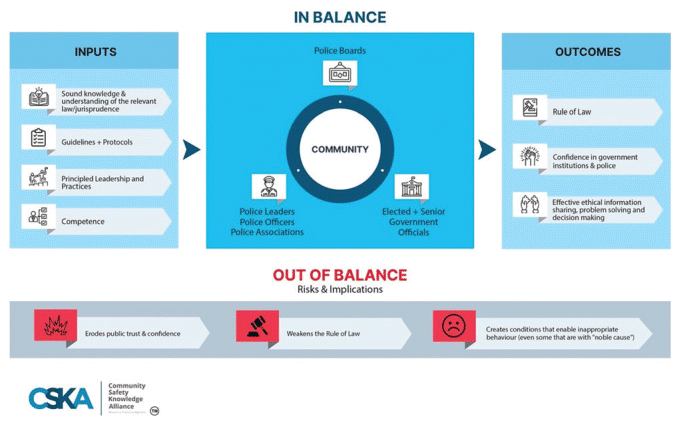
FIGURE 1 The police governance and accountability ecosystem: Police operational independence.
Cal Corley*, Mark Reber*, Rick Linden†
ABSTRACT
The operational independence of the police is a crucial yet often misunderstood aspect of the rule of law in Canada. It is a quasi-constitutional principle established by key court decisions, particularly the Supreme Court of Canada’s ruling in R. v. Campbell (1999). While police boards set significant policy directions, they must avoid intervening in specific operational matters like investigations and arrests, which fall solely under police jurisdiction. This study highlights the delicate balance police must maintain between accountability to police service boards and government, and independence in certain operational decisions to prevent politicization while remaining connected to the communities they serve. Focusing on municipal policing, this report emphasizes the independent role of municipal police agencies in law enforcement, while recognizing their need to collaborate with local governments and police service boards on policy, strategic, and occasionally operational issues. Together, these entities form the police governance and accountability ecosystem. When functioning effectively, this system fosters ethical decision-making and bolsters community confidence; however, when imbalanced, it can erode trust and facilitate misconduct. Thus, it is crucial for all parties to grasp the principles of police operational independence. This report clarifies Canadian jurisprudence on police operational independence, addressing existing gaps in understanding and application among police, boards, and government officials. It synthesizes established legal frameworks and insights from significant inquiries, bolstered by a comprehensive interview program conducted for this study.
Key Words Police operational independence; accountability; governance; influence; interference; rule of law.
In March 2021, while serving as Alberta’s Justice Minister, Kaycee Madu was pulled over for a routine traffic violation and issued a ticket. Approximately 20 minutes later, he called the local police chief under the pretense of discussing another matter but referenced the ticket during the conversation. When Madu mentioned the ticket, the chief tactfully responded by outlining two options: pay the fine or contest it in court, after which the call concluded (Cook, 2022; Rusnell, 2024).
Following this incident, an investigation by retired Court of Queen’s Bench Justice C.A. Kent determined that Madu had attempted to interfere with the administration of justice. The Alberta Law Society’s inquiry further concluded that his actions demonstrated an effort to exploit his position for personal gain, stating, “(the Minister’s) conduct, regardless of his intent, created the appearance of impropriety: that the Minister of Justice and Solicitor General could sidestep the processes available to members of the public facing the same situation” (Wakefield, 2024).
This case is as straightforward as they come, and the police chief handled it appropriately. However, it raises questions about more subtle and nuanced attempts to interfere with police operational independence. As we discuss in this paper, not all situations are as clear-cut as this one, and the complexities involved can make it difficult to discern attempts to improperly influence.
In the Madu case, Justice Kent made a significant observation: neither the police chief nor the minister had undergone formal orientation or training regarding police operational independence (Cook, 2022).
The Charter of Rights and Freedoms states that the rule of law is one of Canada’s founding principles. It recognizes that we need laws to manage society and live together peacefully under the rule of law; no one is above the law. Everyone, including politicians, police officers, and wealthy individuals are treated to the same standards and must obey the law. It also means that political influences have no part in criminal justice processes. In its decision in Reference re Secession of Quebec, [1998] 2 S.C.R. 217, the Supreme Court of Canada stated that,
“The rule of law vouchsafes (accords) to the citizens and residents of the country a stable, predictable, and ordered society in which to conduct their affairs. It provides a shield for individuals from arbitrary state action.” (para. 70)
The operational independence of the police is an important, yet not well understood, feature of the rule of law in our country. It is a quasi-constitutional principle established in Canadian law through several superior court decisions, most notably the Supreme Court of Canada decision in R. v. Campbell (1999). It is akin to independence granted to the judiciary and prosecutors, wherein:
The police must carefully balance being accountable to government while at the same time ensuring that certain types of operational policing decisions (e.g., whether and whom to investigate, arrest, or prosecute) are completely independent of external influence. This is important because in the absence of appropriate independence, there is a real risk of politicizing policing. Alternatively, too much independence on the part of the police can alienate the police from the communities they serve, and risk bringing about unwanted police and political excesses.
Concerns and issues pertaining to police operational independence are as old as modern policing itself. The principle has been the subject of considerable review and discussion in Canada over recent decades most notably in the 1981 McDonald Commission Report concerning certain Royal Canadian Mounted Police (RCMP) national security-related activities – the 2007 Ipperwash Inquiry (Linden) Report; the 2012 Morden Report concerning events at the 2010 G20; the 2021 Epstein Report into missing persons investigations in Toronto; and most recently, the February 2023 Public Order Emergency Commission (POEC; Rouleau) Report concerning the 2022 protests in Ottawa and elsewhere across Canada; and the March 2023 report of the Nova Scotia Mass Casualty Commission (MCC).
Despite existing jurisprudence and numerous inquiries into the pertinent issues, the application of the doctrine of police operational independence – especially in the context of more subtle and nuanced efforts to influence police actions – is often poorly understood. Additionally, police leaders and practitioners, along with those overseeing police governance, must be adept at distinguishing between legitimate discussions among stakeholders and inappropriate attempts to influence police operations or police boards.
This study focuses on municipal policing, a unique aspect of local government in Canada. Municipal police agencies function autonomously in their law enforcement roles, distinguishing them from other municipal departments. Unlike these departments, police agencies operate independently and are not bound by directives from the mayor, city council, or chief administrative officer when it comes to investigative or enforcement matters.
Nevertheless, police agencies must cultivate relationships with local government, their police service boards, and, through these boards, with provincial governments. We refer to this network as the police governance and accountability ecosystem.
This report aims to clarify the relevant Canadian jurisprudence and provide an understanding of how knowledge and understanding of the doctrine, together with its practical application, can be improved. The report provides a synthesis of established law, and interpretations of the law by a series of major commissions of inquiry, largely confirmed through an extensive interview program undertaken for this study.
The research team undertook a comprehensive review of relevant academic literature, publicly available media, and pertinent Canadian jurisprudence, focusing on key interpretations of police operational independence. Additionally, a robust interview program was conducted, involving over 40 interviews over a 2-month period with individuals currently or recently engaged in policing or police governance at municipal, provincial, First Nations, and federal levels. Interviewees included current and former police chiefs, police services board members, and senior government and elected officials. While some interviews are referenced herein, materials from the interviews will form the basis of a follow-up paper that delves further into this subject matter.
It is important to consider key trends that are collectively shaping the police operating environment, highlighting the growing significance of operational independence in the current evolution of policing and community safety in Canada.
Over the past decade, significant shifts at global, national, and local levels have transformed the contexts in which policing and community safety operate, making the issues of police operational independence and political accountability particularly relevant in Canada today.
The nature of crime and harm is evolving, becoming increasingly complex. Many of the most pervasive threats, such as cybercrime, drug trafficking, and human trafficking, are borderless, challenging law enforcement agencies to adapt and respond effectively. Additionally, criminal investigations have grown more intricate and time consuming, policing costs are on the rise, and public confidence in police institutions continues to wane (Council of Canadian Academies, 2014).
These challenges are exacerbated by the expectations of a more sophisticated, diverse, and technologically advanced society, which demands greater responsiveness and accountability from police forces (Walsh & Conway, 2011). This demand has been fuelled by numerous reviews and inquiries into policing practices, ranging from the McDonald Commission’s investigation into illegal RCMP activities in the 1970s to the Linden Inquiry into Ipperwash, the Morden Report on the 2010 G20 Summit in Toronto, the independent civilian review of Toronto’s missing person investigations (Epstein), and the more recent POEC (Rouleau) and Nova Scotia MCC reports.
At risk of further complicating matters, historically and in general terms, police leaders have controlled the relationships with political masters – police boards and elected officials (CBC, 2003). The traditionally closed culture of policing, with its considerable inside knowledge and data holdings, amplified by a lack of understanding of police operational independence on the part of all concerned, has been a contributing factor.
A critical trend in the political sphere also significantly impacts discussions on police operational independence. Recent broad-based calls for social change, exemplified by movements like Black Lives Matter and the Truth and Reconciliation Commission, have heightened expectations for police to address issues of social justice and inclusion.
Conversely, a rise in authoritarian populism in Canada mirrors trends seen in the United States and abroad. This populist movement, characterized by xenophobia, anti-science sentiments, and a lack of empathy toward gender and equity issues, has gained considerable traction, with estimates suggesting that around 34% of Canadians hold such views. Individuals with these beliefs often exhibit deep mistrust of government, heightened perceptions of external threats (particularly regarding immigration and visible minorities), and a tendency to advocate for increased police powers at the expense of civil liberties. Populist governments may respond by undermining police oversight mechanisms or promoting “tough-on-crime” policies that disproportionately target already marginalized communities (Graves & Smith, 2020).
In this context, maintaining police operational independence is more crucial than ever. It ensures that law enforcement can act impartially and uphold democratic values, even amid rising political pressures.
Overall, the police, police service boards, and elected officials genuinely seek constructive dialogue to ensure effective policing and to shape the future of community safety more broadly. However, it is not uncommon for roles and responsibilities to become blurred, leading to occasional breaches of appropriate boundaries.
Municipal police agencies play a unique role within local government. Using Ottawa as the example, Justice Rouleau earlier this year described police services as “not simply another department of the municipal government. It is an independent law enforcement agency that has a relationship not only with the City of Ottawa, but also with the Ottawa Police Services Board and, through it, the Government of Ontario” (Rouleau, Vol. 2, p. 156).
Police operational independence occurs within specific, usually local, contexts but always within what we refer to as a police governance and accountability ecosystem (Figure 1).
|
| ||
|
FIGURE 1 The police governance and accountability ecosystem: Police operational independence. | ||
When functioning properly, the police governance and accountability system upholds the rule of law, fosters public trust and confidence in these institutions, and promotes ethical decision-making and problem-solving (Aust & Aust, 2013). However, as highlighted by the POEC and MCC, any imbalance in this system can undermine public trust and confidence and have a detrimental effect on the rule of law. In such cases, the conditions may arise that allow any participants in the ecosystem to act inappropriately, even with the best of intentions or what is often referred to as a “noble cause.”
Political interference with police operational independence can occur along a spectrum, ranging from subtle, often unintended actions that exert undue influence to more overt instances of political meddling. Abject interference – such as an elected official requesting the withdrawal of a traffic ticket from the chief of police – is well understood and easily recognizable. By contrast, the more subtle and nuanced forms of undue influence can be far more concerning. These incidents are often difficult to identify in real time, yet they can erode public trust and confidence just as effectively as more blatant interferences. Such situations exist in a grey area, making it crucial for those at the police governance nexus to navigate these complexities effectively. Awareness is key to ensuring that these interactions remain principled and do not compromise the integrity of the governance system.
In recent decades, various inquiries and reviews mentioned earlier in this report have examined the issue of police operational independence to varying degrees. The two most recent, the POEC and the MCC, have highlighted a widespread lack of understanding regarding police operational independence throughout the ecosystem – not only among police personnel but across all stakeholders involved. For example,
“Senior public servants . . . were unclear as to what they were allowed to request or expect from the police relating to information, and what police were obligated to provide. They were aware, in general terms, of the principle of operational independence, the concerns identified during the Ipperwash Inquiry, and that government had infringed on this principle in the past. However, a number of them expressed a sense of real frustration that there was information they should have received . . . but did not. They were very cautious for fear of crossing a line that neither they, nor law enforcement, fully understood.” (Rouleau, Vol. 3, pp. 305–306)
Constructive engagement and dialogue between the police, governance bodies, and elected officials are important and necessary features in our democratic system. Examples of such positive engagement abound: elected officials regularly engage with police leaders to better understand local crime trends and policing tactics and to share ideas and concerns. This is as it should be, and as both recent commissions observed, positive and principled exchanges of information and dialogue are important to improving policy and operational decision-making. The MCC noted, however, that all concerned would be well served by the codification of key roles and responsibilities together with protocols on such exchanges.
“In a matter as fundamental to democracy as police/government relations, the police, the government, and the public are not well served when they depend on convention alone.” (MCC, Vol. 5, p. 441)
“In every democracy, individuals and organisations which are intended to have only certain well-defined executive functions are likely, if unchecked, to acquire a very undesirable independent power. This is especially true of the police.” (Russell, 1957, p. 295)
The police are one of the most visible agencies in our democratic system, with Canadians more likely to encounter and interact with police than any other government entity. They serve as the gatekeepers to the criminal justice system, possessing the authority to use force and to deprive individuals of their liberty when necessary.
Thus, it is crucial for democracy that the police operate under the rule of law, free from the influence of political or business interests. They must be held accountable for their actions. As clarified by the Supreme Court of Canada in *R. v. Campbell*, [1999] 1 S.C.R. 565, the police are not considered “servants or agents of the government while engaged in a criminal investigation.” In these situations, police officers act as public office holders rather than subordinates, making independent decisions on such matters as whether to arrest or prosecute. As Aust (2012, p. 48) noted, the distinction between two types of policing roles is important:
“In their role as holders of a public office under a statute, the independent exercise of the peace officer’s broad discretion while conducting a criminal investigation or arrest is limited only by the legal principles that such duties be exercised reasonably and in accordance with the Constitution. The other role is when, as a member of the (police service) executes duties such as transporting prisoners or directing traffic, in which they are subordinate to the orders of their superiors. This places the member in a more traditional role as a subordinate public servant.”
Throughout the extensive interviews conducted for this research, both current and former senior police executives expressed concern over the widespread misunderstanding of police operational independence at all levels of policing. This issue is especially pronounced regarding the more nuanced and subtle forms of “undue influence.” Several executives noted a prevailing culture where their beliefs and understanding of this principle are rooted in outdated or inadequate interpretations passed down from their predecessors. In one interesting twist, a former deputy chief lamented that in their view, many senior police leaders tended to view the findings and recommendations emanating from the Morden, Epstein, and similar reports as applying to such major events as were subject to these inquiries – and not in the context of day-to-day policing.
While enhancing collective understanding within the policing ecosystem is crucial, we contend that the police, as the ultimate guardians of operational independence, must possess an unparalleled grasp of this principle and its practical application. This requirement extends across all levels of the organization – from the chief of police to management and supervisory roles, and down to frontline patrol officers and major crime investigators. As Stenning noted, in such operational circumstances, “it is improper for elected political authorities (such as government ministers or other police governing authorities) to give, or for police to accept from them (emphasis ours), any direction or control, or even significant influence or input” (Pue, 2001, p. 92).
The role of a police executive as a public office holder will often conflict with their role as an employee and “subordinate” of the police board. At times this can come at a heavy cost, including risks of retribution (such as being fired or their employment contract not being renewed) – a concern that was expressed by several of the senior police executives interviewed for this research. The tensions inherent in normal police chief–board relations are best managed through enhancing the trust between a police chief and the board.
As one chief with several years at the helm of his agency put it, “. . . (after these years as chief) it’s probably easier for me to push back, because I know the landscape better than perhaps a newer chief. He added, “even myself, in my first year as chief, you’re still trying to find you way and when it comes to pushing back, you have to be a little bit more subtle about it . . . you’re thinking about self-preservation as well.”
In October 2021, the Peel Regional Police hired its first manager of government relations, with the view to improving communications and working relations with its board and all three levels of government. Operating within the chief’s office, this government relations expert supports the chief and executive in its bilateral relations with its board, local governments, and the provincial government in interactions on issues of mutual interest or concern – all in a non-partisan way. According to the chief of police, the addition of this expertise has gone a long way to improving these important relationships for the betterment of both the police service and the communities it serves.
The principle of operational independence applies equally to all police officers, from newly trained constables to senior executives. However, most interviewees in this research felt that the principle and its practical application are not adequately understood throughout the police service.
Echoing the findings of the Ipperwash Inquiry, the MCC emphasized the importance of ensuring that critical incident commanders and major crimes investigators are “buffered from direct knowledge of government discussions while an investigation is ongoing” (Vol. 5, p. 436).
There is a pressing need for greater awareness and understanding of these principles.
An examination of police operational independence must consider the role of police associations. While democratic policing has traditionally maintained an apolitical stance, many police associations have become increasingly politically engaged in recent decades. For instance, the Ottawa Police Association (OPA) has fluctuated in its involvement with local and provincial politics, notably endorsing a particular political party during a provincial election campaign (Lapierre, 2022). Similarly, the Vancouver Police Association and the Toronto Police Association recently backed candidates in their respective municipal elections. As Shantz (2023) noted, such political engagement raises concerns about the separation of policing and politics, as backing one elected official over another can sometimes come with expectations of quid pro quo arrangements. This involvement can also have a chilling effect on some new Canadians, who may associate “politically active police” with the oppressive regimes they fled, evoking memories of the “police states” they left behind (Freeze, 2000).
A set of recent studies examined the impacts of politicization on a number of institutions, including the police. The research found that:
“. . . the perceived politicization of institutions - the extent to which institutions were perceived as allowing their political values to impact their work - was associated with lower trust toward those institutions, as well as lower willingness to support and defer to their expertise.”
The researchers also suggested that, “once an institution is perceived as politicized, it might be very difficult to undo that perception” (Clark et al., 2023, p. 48).
Police service boards (or police commissions as they are known in some provinces) play an important role in ensuring public confidence in the police and achieving community safety objectives. They typically perform six key functions:
Police boards were originally established by legislation to shield the police from direct oversight by local elected officials and to project an image of legitimacy (Caul, 2009, pp. 82–83; Laming & Valentine, 2022, p. 8). While their independence is crucial, the complexities of community safety necessitate that these boards consult and collaborate with various stakeholders, particularly the police executive, police associations, and elected officials, to make informed and effective independent decisions.
The interviews conducted for this study, along with supporting literature, reveal that police board governance across much of Canada is often ineffective in ensuring adequate and effective local policing. Membership on police boards is often “an awkward mix of councillors and citizens appointed by both cities or provinces, serving with little staff or legal support” (Kelcey, 2022). Board member appointment processes often lack transparency (Roach, 2022, p. 89). Two-year terms are typical but generally expire with political cycles which means that boards often lack continuity.
To maintain independence and protect members from arbitrary dismissal, legislation often outlines the tenure of board members. However, many board members receive little initial orientation or ongoing training. Additionally, most boards operate without significant secretariat support, further hindering their effectiveness.
Interviewees noted that one of the most powerful concepts with respect to police governance in Canada remains the policy-versus-operations distinction. This is meant to maintain the balance between police governance and accountability on the one hand, and police operational independence on the other. Morden (2012) cautioned against the widespread acceptance of this policy – operations divide. The actual relationship between boards and police services is not only far more dynamic but is one which must be worked out on a continuous basis (Sossin, 2004). In addition, some of those interviewed felt that the policy-versus-operations distinction is still maintained because it allows boards and elected officials to avoid any real responsibility for policing, particularly when things have gone wrong (see also Roach, 2022, p. 75).
Some of those we interviewed reported that there was an increasing tendency for municipal politics to extend into police services boards. This was also well documented in previous research (Oppal, 1994; Sossin, 2004) and was highlighted again in the recent POEC report. Several interviewees observed that city councillors appointed to police service boards at times would not “leave their councillor hats at the door.”
The interviews and existing literature clearly indicate a pressing need to enhance board governance. To effectively fulfill their responsibilities, boards must be adequately funded and provided with sufficient resources, such as secretariat support, that align with the size of the police agency. Establishing a permanent executive director, along with appropriate staff, would foster continuity and cultivate internal expertise on effective governance and the critical issues that boards face. This structure would also promote stronger governance relationships with the police service and facilitate the onboarding and support of new board members.
Ultimately, those involved in policing – whether elected officials or board members – must adopt a less deferential stance toward the police and take greater accountability for ensuring community safety (Roach, 2022, p. 190). Both the interviews and the literature (e.g., Roach, 2022, p. 185) emphasize that allowing local political agendas to exert unchecked influence can lead to significant governance and policing failures, as evidenced by the situation in Ottawa in February 2022.
The MCC report (Vol. 5, pp. 539–542) presents a robust and comprehensive recommendation (Recommendation P.61) aimed at enhancing police governance in Nova Scotia. The commission advocates that the provincial government should oversee the design and implementation of mandatory standardized training in police governance for all stakeholders within the police governance and accountability system. The MCC further stated the following:
This, in our view, would set a standard for jurisdictions across Canada.
Governments have an obligation to concern themselves with matters of public safety and policing. As Roach (2022, p. 185) noted, it is often the absence of appropriate political direction – not its presence – that leads to policing problems. Furthermore, it would be unrealistic to expect a “politics-free zone” for policing. Take the example of police budgets – often an issue of considerable debate and disagreement. As one interviewee put it, “It’s the councillor who has to face an angry local taxpayer, not the police board member.”
The influence of politics on local police service boards is well documented (Oppal, 1994; Rouleau, 2023; Sossin, 2004). It is essential to safeguard police and police boards from political interference or undue influence while also recognizing the legitimate role of elected officials in providing policy direction and ensuring accountability for the police. Achieving a balance between appropriate political oversight and police independence requires a delicate balance. Unfortunately, this equilibrium can be easily disrupted (Sossin, 2004, p. 7).
Virtually every municipal government is elected in part with a specific law and order agenda as part of their platform, and yet there are usually scarce public resources available to fulfill that agenda. The distinction between the executive’s view on the “public interest” and its own partisan interests may often appear “blurred.” The police–government relationship can be a difficult territory to navigate, particularly if one does not possess a corresponding “political compass” (Sossin, 2004, p. 37).
Add to this the 24/7 news cycles, citizen journalists armed with cell phone cameras and the ability to use social media to quickly garner immediate national or even international attention. This places enormous pressure on elected officials to respond. So, it is easy to see why many elected officials often weigh in – appropriately or not – on policing issues.
Many police chiefs interviewed emphasized the importance of keeping their mayors and councils regularly informed about community safety issues. This practice ensures that elected officials are aware of key trends and specific police strategies while reinforcing the police board’s role as the legitimate governing authority.
However, as supported by our interviews and the literature (e.g., Roach, 2022; Sossin, 2004), there will always be a risk of political influence in police governance, regardless of existing protocols. This underscores the need for heightened awareness and guidance to promote democratic policing and uphold the rule of law.
Policing operates within a complex political landscape, particularly in Canada’s liberal democratic framework, where police must balance accountability to the government with operational independence. This independence, while essential and evolving, is not absolute. Recent inquiries underscore the need for enhanced dialogue among police, governance bodies, and elected officials, allowing for independent decision-making while maintaining accountability to democratic institutions.
Justice Rouleau emphasized that while governments influence policing decisions, excessive control risks undermining impartial law enforcement, whereas insufficient oversight may lead to self-governance by police (Rouleau, Vol. 2, p. 69). This operational independence exists within a governance and accountability ecosystem that, when well balanced, promotes the rule of law and public trust. Conversely, imbalances – evident in recent inquiries – can erode confidence and lead to misconduct.
The spectrum of police operational independence ranges from inappropriate influence to overt political interference. While blatant incidents are recognizable, subtle influences pose greater risks over time. Proper governance of police is increasingly critical amid rising policing costs, evolving crime dynamics, and societal demands for change. Effective engagement among police leaders, governance bodies, and elected officials is essential for navigating these challenges.
Evidence suggests that improvements in the police–governance relationship are both possible and necessary.
The following recommendations come out of the work completed in this review:
Recommendation #1: That provincial departments of justice develop and provide mandatory standardized training in police governance, and that such training be mandatory for the following:
This recommendation echoes that of the MCC Recommendation P.61. The MCC emphasizes that training should
This standardized training should be ongoing and cyclical, rather than a one-time event.
Recommendation #2: That police training institutions ensure their curricula (i.e., recruit training, in-service operational courses, and leadership and executive development) provide sufficient attention to the doctrine of police operational independence.
Recommendation #3: That provincial police legislation be strengthened to provide that:
This aligns with MCC Recommendation P.38, as well as Section 62(1) of Ontario’s Community Safety and Policing Act, 2019.
Recommendation #4: That provincial police legislation be strengthened to provide that:
This recommendation flows from MCC Recommendation P.39.
Recommendation #5: That police chiefs ensure that their employment contracts provide sufficient enumeration and clarity on the respective roles and responsibilities of the chief and the police board.
Recommendation #6: That police services establish local policies and procedures to protect investigators, incident commanders, and frontline officers from exposure to direct government or direct police board intervention or advice.
This recommendation echoes MCC Recommendation P.40.
Recommendation #7: That municipalities provide police boards with sufficient funding to enable the full range of activities required to exercise proper governance.
Recommendation #8: That as a matter of practice, municipal and provincial governments confer with one another to ensure mutual understandings of the extant capability and capacity requirements of a police board when preparing to select new police board members.
While the recommendations outlined previously may not be groundbreaking, their effective implementation is crucial for significantly enhancing the police governance and accountability system.
By adopting these measures, we can ensure police operational independence, while ensuring that appropriate dialogue between the various parties can occur, with everyone clear on the boundaries established in jurisprudence. Police must operate free from both actual and perceived political influence, fostering an environment where impartiality and fairness are paramount. Maintaining appropriate accountability to our democratic institutions is also essential for upholding the rule of law and reinforcing public trust in these vital entities.
Moreover, by prioritizing transparency and accountability, these recommendations can help instill greater trust and confidence in government institutions and the police among the community. When citizens believe that the police operate independently and ethically, it strengthens the relationship between the police and the communities they serve. Ultimately, these enhancements will contribute to a more effective policing model that is responsive to the needs of the public while respecting the principles of democracy.
The authors have no conflicts of interest to declare.
*Community Safety Knowledge Alliance, Ottawa, ON – Saskatoon, SK, Canada
†University of Manitoba, Winnipeg, MB, Canada
Aust, A. E. (2012, August 28). The challenge and the Royal Canadian Mounted Police. Report of the independent inquiry into the mandate, the structure and the operations of the Royal Canadian Mounted Police Pay Council. RCMP.
Aust, A. E., Aust, T. L. (2013, August 15). Reflections on police independence, governance and evolution. Presentation to Canadian Association of Police Boards, Saskatoon, SK.
CBC Ideas. (2003). The power of the police. Part 5: In search of security (series). CBC Radio One. Accessed May 26, 2022, from https://www.davidcayley.com/podcasts/2018/2/26/in-search-of-security
Caul, D. (2009). Municipal police governance in Canada: An examination of the relationship between board structure and police independence. Simon Fraser University.
Clark, C. J., Isch, C., Everett, J. A. C., Shariff, A. F. (2023). Even when ideologies align, people distrust politicized institutions [Manuscript in preparation]. University of Pennsylvania. https://www.researchgate.net/publication/370025043_Even_When_Ideologies_Align_People_Distrust_Politicized_Institutions
Cook, S. (2022, February 25). Madu out as justice minister after investigation found he tried to interfere with administration of justice. CBC News. https://www.cbc.ca/news/canada/edmonton/alberta-kay-cee-madu-justice-investigation-cabinet-shuffle-1.6365261
Council of Canadian Academies. (2014). Policing Canada in the 21st century: New policing for new challenges. The Expert Panel on the Future of Canadian Policing Models, Council of Canadian Academies. https://www.cca-reports.ca/reports/policing-canada-in-the-21st-century-new-policing-for-new-challenges/
Freeze, C. (2000, November 6). Police Union and Politics a Volatile Mix. The Globe and Mail. https://www.theglobeandmail.com/news/national/police-union-and-politics-a-volatile-mix/article4168561/
Graham, A., Kaustinen, F. (2019, August). Police governance at a crossroads. Canadian Association of Police Governance, Annual Conference Report: Community Safety, Community Service, Community Strength, Calgary, AB. http://capg.ca/wp-content/uploads/2019/10/2019-CONFERENCE-REPORT-FINAL.pdf
Graves, F., Smith, J. (2020). Northern populism: Causes and consequences of the new ordered outlook. School of Public Policy Publications, University of Calgary, 13(15). https://d3n8a8pro7vhmx.cloud-front.net/cdfai/pages/4588/attachments/original/1610483508/Northern_Populism_Causes_and_Consequences_of_the_New_Ordered_Outlook.pdf?1610483508
Kelcey, B. (2022, March 14). Ottawa’s police board crisis is just the tip of Canada’s police-governance problem. The Globe and Mail. https://www.theglobeandmail.com/opinion/article-ottawas-police-board-crisis-is-just-the-tip-of-canadas-police/
Laming, E., Valentine, G. (2022, March). Police governance in Canada: Variations and disparities among police service boards. Canadian Public Administration, 65(1), 7–27. https://doi.org/10.1111/capa.12448
Crossref
Lapierre, M. (2022, October 19). Ottawa Police Association releases statement slamming mayoral candidate Catherine McKenney. Ottawa Citizen. https://ottawacitizen.com/news/local-news/ottawa-police-association-releases-statement-slamming-mayoral-candidate-catherine-mckenney
Linden, S. B. (2007). The Ipperwash Inquiry Report. Government of Ontario. https://www.ontario.ca/page/ipperwash-inquiry-report
Mass Casualty Commission. (2023, March 30). Turning the tide together: Final report of the Mass Casualty Commission: The Joint Federal/Provincial Commission into the April 2020 Nova Scotia mass casualty. Mass Casualty Commission. https://masscasualtycommission.ca/final-report/
McDonald, D. C. (1981). Commission of inquiry concerning certain activities of the Royal Canadian Mounted Police – Volume 2: Freedom and Security Under the Law. Government of Canada, Privy Council Office. https://www.securitepublique.gc.ca/cnt/rsrcs/lbrr/ctlg/dtls-en.aspx?d=PSi=367909
Morden, J. W. (2012). Independent civilian review into matters relating to the G20 Summit. Toronto Police Services Board. https://tpsb.ca/images/pdf/REPORT_ICR_Morden_executivesummary.pdf
Oppal, W. T. (1994). Closing the gap: Policing and the community. Commission of inquiry into policing in British Columbia. https://opcc.bc.ca/wp-content/uploads/2017/04/Closing_The_Gap-Recommendations.pdf
Pue, W. (2001, Spring). The prime minister’s police? Commissioner Hughes’ APEC report. Osgoode Hall Law Journal, 39(1), 165–185. https://core.ac.uk/download/pdf/232617176.pdf
Crossref
Roach, K. (2022). Canadian policing: Why and how it must change. Delve Books, Irwin Law.
Rouleau, P. S. (2023). Report of the public inquiry into the 2022 Public Order Emergency. Ottawa, ON. https://publicorderemergencycommission.ca/final-report/
Rusnell, C. (2024, June 24). Inside the disciplinary hearing for Kaycee Madu. The Tyee. https://thetyee.ca/Analysis/2024/06/24/Disciplinary-Hearing-Kaycee-Madu/
Russell, B. (1957). Power: A new social analysis (pp. 61–86). Allen and Unwin Ltd.
R. v. Campbell, CanLII 676 (SCC), 1 SCR 565 (1999). https://scc-csc.lexum.com/scc-csc/scc-csc/en/item/1692/index.doc
Shantz, J. (2023, February 21). Policing and politics are not a good mix. The Hamilton Spectator. https://www.thespec.com/opinion/contributors/policing-and-politics-are-not-a-good-mix/article_cd932d2a-3e82-56fd-9c02-38455ca8da35.html
Sossin, L. (2004). The oversight of executive police relations in Canada: The constitution, the courts, administrative processes and democratic governance. Ipperwash Inquiry: SSRN. https://ssrn.com/abstract=1911409
Wakefield, J. (2024, October 18). Why Alberta’s Law Society decided to sanction former Justice Minister Kaycee Madu. The Edmonton Journal. https://edmontonjournal.com/news/crime/kaycee-madu-law-society-decision
Walsh, D. P., Conway, V. (2011). Police governance and accountability: Overview of current issues. Crime Law and Social Change, 55(2), 61–86. https://doi.org/10.1007/s10611-011-9269-6
Crossref
Correspondence to: Cal Corley, Community Safety Knowledge Alliance, Young, SK S0K 4Y0, Canada. E-mail: ccorley@cskacanada.ca
This work is licensed under the Creative Commons Attribution-NonCommercial-NoDerivatives 4.0 International License. To view a copy of this license, visit http://creativecommons.org/licenses/by-nc-nd/4.0/. For commercial re-use, please contact sales@sgpublishing.ca.
Journal of CSWB, VOLUME 10, NUMBER 1, March 2025